
● 2026 COMPLETE GUIDE · UPDATED MONTHLY
Generative AI Models
What Are Generative AI Models?
Generative AI models are advanced artificial intelligence systems that learn patterns, structures, and relationships from massive datasets to create entirely new content including text, images, videos, music, speech, software code, 3D assets, and synthetic data.
Unlike traditional AI systems that primarily classify, predict, or analyze existing information, generative AI creates original outputs that closely resemble human-created content using deep learning and neural network architectures.
Modern generative AI powers platforms such as OpenAI ChatGPT, Google Gemini, Anthropic Claude, Midjourney Midjourney, and Stability AI Stable Diffusion.
How Generative AI Models Work
Generative AI models operate by training on enormous datasets containing text, images, audio, video, or code. During training, the model learns statistical relationships and hidden patterns inside the data using neural networks and optimization algorithms.
The typical generative AI pipeline includes:
- Data Collection — Gathering large-scale datasets
- Data Preprocessing — Cleaning and tokenizing information
- Model Architecture Selection — Choosing Transformers, GANs, Diffusion Models, or VAEs
- Training — Learning patterns through gradient optimization
- Fine-Tuning — Specializing the model for specific tasks
- Inference — Generating outputs from prompts or inputs
- Evaluation — Measuring quality using metrics like BLEU, ROUGE, FID, and Human Evaluation
- Deployment & Monitoring — Running the model in production environments
Large Language Models (LLMs) such as GPT-4 and Gemini are trained on trillions of tokens using distributed GPU clusters and reinforcement learning techniques like RLHF (Reinforcement Learning from Human Feedback).
| Model Type | What It Is | How It Works | Best For | Main Strength | Main Weakness | Famous Models / Examples | Common Applications |
|---|---|---|---|---|---|---|---|
| GANs (Generative Adversarial Networks) | Two neural networks competing against each other | A Generator creates fake data while a Discriminator detects fake vs real | Realistic image generation | Extremely realistic visuals | Difficult and unstable training | StyleGAN, CycleGAN, DeepFake | Face generation, photo enhancement, super resolution |
| Diffusion Models | Models that generate data by gradually removing noise | Start with random noise and iteratively denoise into image/video/audio | AI art and high-quality generation | Outstanding image quality | Slow inference and expensive computation | DALL·E, Stable Diffusion, Midjourney | AI art, video generation, image editing |
| VAEs (Variational Autoencoders) | Probabilistic latent-space models | Compress data into latent vectors then reconstruct it | Compression and representation learning | Smooth latent space and controllable generation | Outputs can look blurry | VQ-VAE, Beta-VAE | Image compression, anomaly detection |
| Transformers | Attention-based deep learning architecture | Uses self-attention to understand token relationships | Text, reasoning, multimodal AI | Highly scalable and versatile | Requires massive datasets and compute | GPT-4, Claude, Gemini, Llama | Chatbots, coding AI, search, translation |
| Autoregressive Models | Sequential prediction models | Predict the next token/word/pixel step-by-step | Text generation | Natural and coherent language | Slow sequential generation | GPT series, PixelRNN | Writing, summarization, code generation |
| Flow-Based Models | Exact likelihood generative models | Learn reversible transformations between data and latent space | Density estimation | Exact probability calculation | Hard to scale to large datasets | Glow, WaveGlow | Speech synthesis, scientific modeling |
| RNNs / LSTMs | Sequential neural networks | Maintain memory across sequences | Early NLP and speech tasks | Good for sequence data | Weak long-term memory compared to transformers | LSTM Text Generators | Speech recognition, text prediction |
| Energy-Based Models | Models using energy functions | Assign lower energy to realistic samples | Representation learning | Flexible mathematical framework | Hard optimization process | Boltzmann Machines | Physics simulation, recommendation systems |
| Normalizing Flows | Invertible neural networks | Transform simple distributions into complex ones | Probability modeling | Exact latent mapping | Computationally expensive | RealNVP, Glow | Audio generation, density estimation |
| Multimodal Models | Models trained on multiple data types | Combine text, image, audio, and video understanding | Human-like AI interaction | Rich contextual understanding | Large infrastructure cost | GPT-4o, Gemini Ultra | Voice assistants, AI agents |
| Retrieval-Augmented Generation (RAG) | Models enhanced with external knowledge retrieval | Retrieve documents before generating answers | Knowledge-intensive tasks | More accurate and updated answers | Depends on retrieval quality | Perplexity AI, ChatGPT + RAG systems | Enterprise search, AI assistants |
| Mixture of Experts (MoE) | Sparse activation architecture | Only selected expert networks activate per task | Efficient large-scale AI | Scales efficiently | Complex routing systems | Mixtral, Switch Transformer | Massive AI systems |
| Diffusion Transformers (DiT) | Combination of transformers and diffusion models | Transformer architecture inside diffusion pipelines | High-end image/video generation | Better scalability and quality | Very compute intensive | Sora, DiT | Video generation, cinematic AI |
| Graph Generative Models | Graph-structured data generators | Generate nodes and relationships | Molecules and networks | Strong relational understanding | Complex training | GraphVAE | Drug discovery, social networks |
| Reinforcement Learning Generative Models | Models trained using rewards | Learn generation strategies through feedback | Interactive AI systems | Adaptive learning | Expensive training | RLHF-based GPT models | AI assistants, robotics |
| Hybrid Generative Models | Combination of multiple architectures | Blend strengths of different models | Advanced AI systems | Better flexibility and performance | Complex system design | GPT-4o hybrid systems | Multimodal AI platforms |
Table of Contents
ToggleReal Examples You Know
Generative AI vs Traditional AI
| Feature | Traditional AI | Generative AI |
|---|---|---|
| Main Job | Predicts outcomes | Creates new content |
| Focus | Classification & detection | Generation & creativity |
| Example Task | Fraud detection | Write a story |
| Output | Label or number | Text, image, audio, video |
| Training Data | Labeled datasets | Massive unlabeled data |
| Creativity | Pattern recognition only | Simulates creativity |
| Example Tools | Spam filters, analytics | ChatGPT, Midjourney |
Evolution of Generative AI
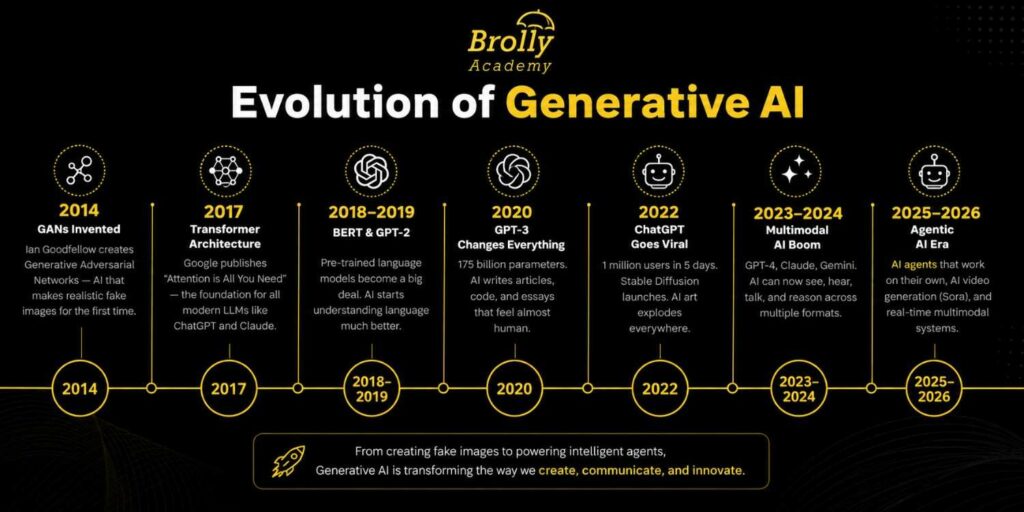
2014
GANs Invented
Ian Goodfellow creates Generative Adversarial Networks — AI that makes realistic fake images for the first time.
2017
Transformer Architecture
Google publishes “Attention is All You Need” — the foundation for all modern LLMs like ChatGPT and Claude.
2018–2019
BERT & GPT-2
Pre-trained language models become a big deal. AI starts understanding language much better.
2020
GPT-3 Changes Everything
175 billion parameters. AI writes articles, code, and essays that feel almost human.
2022
ChatGPT Goes Viral
1 million users in 5 days. Stable Diffusion launches. AI art explodes everywhere.
2023–2024
Multimodal AI Boom
GPT-4, Claude, Gemini. AI can now see, hear, talk, and reason across multiple formats.
2025–2026
Agentic AI Era
AI agents that work on their own, AI video generation (Sora), and real-time multimodal systems.
Generative ai Models – Example With Digital Kitchen
How Do Generative AI Models Work?
8 simple steps — like baking a very smart cake
Data Collection
The AI reads BILLIONS of examples — websites, books, images, videos. More data = smarter AI.
Data Preprocessing
Clean up the data. Remove junk, fix errors, and convert everything into numbers the AI understands.
Architecture Selection
Pick the AI’s brain design. Transformer? GAN? Diffusion? Each has different strengths.
Model Training
The AI practices millions of times. Makes guesses, checks if wrong, adjusts. Uses HUGE computers!
Fine-Tuning
After basic training, the AI gets special training for specific tasks like medical writing or coding.
Inference (Using It)
When you type a prompt, the AI uses what it learned to generate a response in real-time.
Evaluation
Experts test the AI with special metrics (BLEU, FID) to see how good it is at its job.
Deployment & Monitoring
The AI goes live! Engineers watch it constantly to catch errors, biases, or problems.
Key Concepts Explained Simply
Big words made easy — no PhD required!
Neural Networks
A computer system inspired by the human brain. Layers of neurons (math functions) work together to recognize patterns.
Latent Space
A hidden idea space inside the AI where all knowledge is stored as numbers. The AI explores it to find answers.
Attention Mechanism
The AI's ability to focus on the most important parts of what you wrote. Like focusing on key words when reading.
Tokenization
Breaking text into small chunks called tokens. Each token is converted to a number the AI understands.
Embeddings
Converting words/images into number lists that capture meaning. Similar things get similar numbers.
Probabilistic Modeling
The AI calculates the probability of every possible next word or pixel, then picks the most likely option.
Inference
When you use an already-trained AI to get answers. Fast! Different from training, which is slow & expensive.
Vector Databases
Special storage that saves embeddings so AI can quickly search millions of documents for the most relevant info.
What is Latent Space in simple words? Imagine all knowledge in the world squished into a small box. Every idea, word, or image has its own location inside that box. Latent space is that box! Generative AI walks around inside it to create new things by combining existing ideas in new ways.
6 Types of Generative AI Models
VAE — Variational Autoencoders
Think of it as a smart compressor. Squishes data into a small code, then expands it back into something new.
How It Works:
- Encoder compresses input into latent space
- Decoder rebuilds from compressed code
- Learns smooth, structured representations
Best For:
Data Synthesis
GAN — Generative Adversarial Networks
Two AIs fight each other! Generator makes fakes. Discriminator tries to catch the fakes. They keep improving!
How It Works:
- Generator creates fake content
- Discriminator judges: real or fake?
- Both keep improving together
Best For:
Autoregressive Models
Generates content one piece at a time, like writing word-by-word. Each word depends on previous words.
How It Works:
- Predicts next token from previous ones
- Runs sequentially (one at a time)
- Extremely good at text generation
Best For:
Diffusion Models
Starts with static noise and slowly removes it until a beautiful image appears. Used in Stable Diffusion and DALL·E.
How It Works:
- Forward: add noise step by step
- Reverse: learn to remove noise
- Guided by text prompts to create images
Best For:
Flow-Based Models
./Uses mathematical transformations that can go both ways, compress data AND perfectly reconstruct it.
How It Works:
- Invertible transformations
- Exact likelihood calculations
- Lossless encoding and decoding
Best For:
Transformer Models
The king of modern AI! Uses attention to understand relationships between words across entire documents.
How It Works:
- Attention mechanism focuses on key info
- Processes all words at once
- Scales to billions of parameters
Best For:
Side-by-Side Comparison of All Model Types
| Model Type | Best For | Main Strength | Main Weakness | Famous Example |
|---|---|---|---|---|
| GANs | Realistic images | High visual quality | Unstable training | StyleGAN, DeepFake |
| Diffusion Models | AI art, video | Amazing quality | Slow generation | DALL·E, Stable Diffusion |
| VAEs | Data compression | Structured latent space | Blurry outputs | VQ-VAE |
| Transformers | Text & reasoning | Scalable, versatile | Needs huge data | GPT-4, Claude, Gemini |
| Autoregressive | Text generation | Natural language quality | Slow (sequential) | GPT series |
| Flow Models | Density estimation | Exact likelihood | Hard to scale | Glow, WaveGlow |
Large Language Models (LLMs)
The AI brains behind ChatGPT, Claude, Gemini & more!
What is an LLM? A Large Language Model is a transformer-based AI trained on trillions of words. So big it can write essays, answer questions, write code, translate languages, and solve math problems.
Top LLMs Compared (2026)
| Model | Company | Parameters | Specialty | Open Source? |
|---|---|---|---|---|
| GPT-4o | OpenAI | ~1.8T (est.) | Multimodal, text, reasoning | ❌ No |
| Claude 3.5 | Anthropic | Unknown | Long context, safety, reasoning | ❌ No |
| Gemini Ultra | Unknown | Multimodal, search integration | ❌ No | |
| Llama 3 | Meta | 70B–405B | Open-source AI | ✅ Yes |
| Mistral Large | Mistral AI | ~56B | Efficient, multilingual | Partly |
| BLOOM | BigScience | 176B | Multilingual, open research | ✅ Yes |
| Falcon | TII UAE | 40B–180B | Open-source, Arabic, English | ✅ Yes |
GPT Evolution: Getting Bigger & Smarter
| Model | Year | Parameters | Key Achievement |
|---|---|---|---|
| GPT-1 | 2018 | 117 Million | First GPT — basic text completion |
| GPT-2 | 2019 | 1.5 Billion | So good OpenAI was scared to release it |
| GPT-3 | 2020 | 175 Billion | Writes human-like articles, code, poetry |
| GPT-4 | 2023 | ~1 Trillion | Understands images + text, passes bar exam |
| GPT-4o | 2024 | Unknown | Real-time voice, vision, multimodal |
BERT (Encoder Only)
- Reads text in both directions (left + right)
- Great at understanding meaning
- Used for search, classification, Q&A
- Can't generate long text
- Made by Google in 2018
GPT (Decoder Only)
- Reads text left-to-right only
- Great at generating new text
- Powers ChatGPT, Copilot, Claude
- Can write essays, code, stories
- Made by OpenAI in 2018+
Best Strategies for Training AI Models
How do you make an AI smarter? Here’s the secret recipe!
Transfer Learning
Start with a model that already knows a lot, then teach it your specific topic. Way faster than starting from scratch.
RLHF (Human Feedback)
Humans rate the AI's answers. The AI learns from those ratings to give better responses. How ChatGPT became helpful & safe.
LoRA (Low-Rank Adaptation)
A cheap trick to fine-tune huge AI models without massive computers. Only updates a tiny fraction of settings, very efficient.
Distributed Computing
Training across hundreds or thousands of GPUs at the same time. Like 10,000 students solving a problem together.
Data Augmentation
Artificially create more training data by flipping images, changing word order, adding noise. Learns more from limited data.
Synthetic Data Training
Use AI to generate training data for another AI! Useful when real data is rare or private, like medical AI.
How Do We Measure AI Quality?
Special scores that tell us if the AI is doing a good job!
| Metric | Used For | What It Measures | Higher = Better? |
|---|---|---|---|
| BLEU Score | Translation, NLP | Similarity to human text | ✅ Yes |
| ROUGE | Summarization | Coverage of key information | ✅ Yes |
| FID Score | Image generation | Realism of AI-generated images | ❌ Lower is better |
| Perplexity | Language models | Prediction accuracy on new text | ❌ Lower is better |
| Human Eval | All AI systems | Human rating of AI outputs | ✅ Yes |
| Latency | Production AI | Response speed of AI systems | ❌ Lower is better |
| Bias Metrics | Fairness testing | Equality and fairness in outputs | ❌ Lower bias is better |
AI Model Performance Indicators
Real-World Applications of Generative AI
Where is AI being used right now? Everywhere!
Image Generation
Create artwork, product photos, logos, book covers from text. Midjourney, DALL·E, Stable Diffusion.
Content Writing
Write blogs, emails, ads, social posts, reports in seconds. ChatGPT, Claude, Jasper.
Software Development
Write, debug, and explain code 10x faster. GitHub Copilot, Cursor, Claude, Replit AI.
Music & Audio
Generate original songs, sound effects, voiceovers, and podcasts. Suno, Udio, ElevenLabs.
Video Generation
Create realistic videos from text prompts. Sora, Runway ML, Pika Labs.
Healthcare
Find new medicine candidates, analyze medical scans, summarize patient records. Saves years!
Education & Tutoring
Personalized AI tutors that adapt to every student's level. Khanmigo, Duolingo AI.
Cybersecurity
Detect threats, write security reports, simulate attacks, analyze malware code.
AI Search Engines
Google AI Overviews, Perplexity AI, and Bing AI generate direct answers.
E-commerce & Retail
Virtual try-on, personalized recommendations, AI-written product descriptions.
Data Analytics
Ask in plain English, get charts and insights. No SQL required! Microsoft Copilot.
Gaming
AI-generated game levels, NPC dialogue, character skins, entire game worlds on demand.
AI Agents — The Next Level of AI
AI that doesn’t just answer — it actually DOES things for you!
What is an AI Agent? An AI assistant that can browse the web, write code, run it, check results, and fix errors on its own — without you saying anything! It plans, acts, and learns.
AI Assistants
Respond to your questions in conversation. Siri, Alexa, Google Assistant, ChatGPT.
Autonomous Agents
Work on their own without constant instructions. Like a self-driving car making decisions.
Multi-Agent Systems
Multiple AI agents working as a team. One writes code, another tests, another deploys!
AI Copilots
Work alongside humans, you're in charge but the AI helps. Microsoft Copilot, GitHub Copilot.
RAG vs Fine-Tuning vs Prompt Engineering
| Technique | What It Does | Cost | When To Use | Example |
|---|---|---|---|---|
| Prompt Engineering | Improves AI responses using better prompts | Free | First method to try | “Act as an expert doctor.” |
| RAG | Connects AI with external documents | Medium | Need real-time information | AI answers from company files |
| Fine-Tuning | Trains AI on custom datasets | Expensive | Need specialized behavior | Medical AI trained on notes |
What is RAG? RAG (Retrieval-Augmented Generation) gives the AI a search engine! Instead of relying only on training, the AI first searches your documents or the web to find relevant info, then writes an answer using that real data. Dramatically reduces hallucinations.
Generative AI Risks & Security Challenges
AI is powerful but comes with real dangers. Know them!
Deepfakes & Misinformation
AI can create fake videos, photos, and voice recordings that look completely real. Used to spread false information or impersonate politicians.
Data Privacy & Leakage
AI trained on private data might accidentally reveal personal information. Employees may share trade secrets with chatbots.
Prompt Injection Attacks
Hackers hide secret instructions inside documents or websites to trick AI agents into doing harmful things.
AI Bias & Discrimination
AI trained on biased data may produce unfair outputs, discriminating by race, gender, or language.
Copyright & IP
AI trained on copyrighted content may reproduce protected work. Ongoing lawsuits from artists & publishers.
High Compute Costs
Training large AI models requires enormous computing power and electricity — creating environmental concerns.
AI Security Best Practices
- Never share private or sensitive company data with public AI tools
- Use enterprise AI tools with proper data privacy agreements
- Always verify important AI-generated facts before publishing
- Implement prompt injection defenses in AI applications
- Regularly audit AI outputs for bias and harmful content
- Keep humans in the loop for high-stakes decisions
- Use watermarking tools to detect AI-generated content
- Train employees on safe and responsible AI usage
AI Hallucinations — When AI Makes Stuff Up!
The weirdest and most dangerous AI problem explained simply.
What is an AI Hallucination? When an AI confidently states something completely false as if it were true. Like if you asked a student what year WWII ended and they said ‘1955 — I’m certain!’ That’s a hallucination. The AI doesn’t know it’s wrong.
Why Do Hallucinations Happen?
- AI learns patterns, not actual facts
- Tries to be helpful even when uncertain
- Training data may contain errors
- Some knowledge gaps filled with guesses
- No way to say I don't know by default
How To Prevent Hallucinations
- Use RAG to ground AI in real documents
- Ask AI to cite its sources
- Have humans fact-check important outputs
- Use RLHF training to reward honesty
- Fine-tune on domain-specific accurate data
AI Governance & Responsible AI
Rules and principles to make sure AI is used for good!
Transparency
People should know when they're talking to AI. AI systems should explain reasoning when possible.
Fairness
AI should treat everyone equally, regardless of race, gender, age, religion, or nationality.
Privacy
AI systems must protect personal data and comply with laws like GDPR and other regulations.
Human Oversight
Critical decisions (medical, legal, financial) must always have a human reviewing AI output.
Accountability
Companies must take responsibility for AI actions and mistakes. Clear lines of responsibility.
Compliance
Follow EU AI Act, US AI Executive Orders, and industry standards for safe AI deployment.
✅ Enterprise AI Governance Checklist
- Document all AI systems used and their purposes
- Conduct bias audits before deploying AI in hiring, lending, or healthcare
- Create AI usage policies and train all employees
- Establish a human review process for high-stakes AI decisions
- Maintain data provenance records for training datasets
- Monitor AI outputs continuously for drift and errors
- Have a clear incident response plan for AI failures
- Publish transparency reports on AI usage annually
Generative AI Across Industries
Who’s using it and how? Here’s the industry breakdown!
| Industry | How They Use Generative AI | Example Tools | Impact |
|---|---|---|---|
| Healthcare | Drug discovery, radiology, clinical notes | AlphaFold, Med-PaLM | Faster medical research |
| Media & Marketing | Content creation, SEO, ad copy | ChatGPT, Jasper, Adobe Firefly | Faster content production |
| Software Development | Code generation, debugging, documentation | GitHub Copilot, Cursor | Faster software delivery |
| Finance & Banking | Fraud detection, reporting, risk analysis | Custom LLMs | Reduced operational costs |
| Education | Personalized tutoring, quiz generation | Khanmigo, Duolingo | Improved learning outcomes |
| Retail & E-commerce | Product descriptions, AI chatbots | Shopify AI, Adobe AI | Higher sales conversions |
| Legal | Contract review, legal research | Harvey AI, Lexis AI | Time savings in legal work |
| Gaming | NPC dialogue, level design, concept art | Unity AI, NVIDIA ACE | Richer gaming experiences |
Future Trends in Generative AI (2026+)
What’s coming next? Here are the most exciting developments!
Real-Time Multimodal AI
AI that sees, hears, and responds instantly. Video calls with AI that understands gestures and expressions.
AI + Robotics
Physical robots controlled by LLMs that understand natural language. Tell a robot 'make me coffee' and it figures it out.
AI Video Explosion
Text-to-video goes mainstream. Hollywood-quality from simple scripts. Every creator becomes a filmmaker.
Autonomous AI Agents
AI that plans and executes complex multi-step tasks independently, research, code, deploy, report.
Personalized AI Companions
AI that knows your history, preferences, and goals. A personal assistant that remembers everything.
Quantum AI Possibilities
Quantum computers could train AI models millions of times faster, unlocking unimaginable capabilities.
Enterprise AI Transformation
Every major company will have custom AI models for their industry, workflows, and data.
AI Regulation Maturity
Governments worldwide will create comprehensive AI laws. EU AI Act becomes the global standard.
Best Practices for AI Adoption
Don’t just use AI — use it smartly and responsibly!
Do This
- Start small with one use case before scaling
- Always review AI outputs before publishing
- Train your team on prompt engineering basics
- Use enterprise AI tools with data privacy built-in
- Set clear KPIs to measure AI ROI
- Keep humans responsible for final decisions
- Continuously monitor AI performance
- Share AI wins and lessons learned internally
Don't Do This
- Don't share passwords or sensitive data with public AI
- Don't publish AI content without human review
- Don't use AI for critical decisions without oversight
- Don't assume AI is always right or current
- Don't ignore AI bias in your outputs
- Don't violate copyright with AI-generated content
- Don't forget to update AI policies regularly
- Don't use AI to deceive customers or users
Free Download: Generative AI Models Ultimate Cheat Sheet
Everything in this guide, summarized on a single, printable PDF. Perfect for students, developers, and business leaders!
Frequently Asked Questions
Generative AI models are computer programs that can create new content — text, images, music, videos, and code — by learning patterns from massive amounts of existing data.
They work in 8 steps: collect data, preprocess it, choose an architecture, train the model, fine-tune, run inference, evaluate quality, and deploy & monitor.
Transformer models are a type of neural network that uses an attention mechanism to understand relationships between words across an entire text at once. They are the foundation of ChatGPT, Claude, Gemini.
GANs use two competing neural networks. Diffusion models start with random noise and gradually remove it. Diffusion models generally produce higher quality images, but are slower than GANs.
Famous examples: ChatGPT & GPT-4 (text), Claude (reasoning), Gemini (multimodal), Midjourney, DALL·E, Stable Diffusion (images), Sora, Runway (video), Suno, Udio (music), GitHub Copilot (code), ElevenLabs (voice).
RAG (Retrieval-Augmented Generation) searches your documents or the web first, then generates an answer using that real data. Greatly reduces AI hallucinations.
AI learns statistical patterns rather than facts. When uncertain, the AI generates the most statistically likely response — which may be false. Solutions: RAG, RLHF training, human fact-checking.
Healthcare, software development, marketing, education, legal, finance, gaming, and retail — virtually every industry.
Deepfakes, data privacy leakage, prompt injection, AI bias, copyright infringement, job displacement, and over-reliance on wrong outputs.
AI will change many jobs — automating repetitive tasks and assisting creative work. Most experts say the future is human-AI collaboration, not replacement.
Latent space is a compressed, abstract representation of all data inside an AI model. Similar things are located near each other.
In 3 phases: (1) Pre-training on massive text datasets, (2) Supervised fine-tuning, and (3) RLHF (Reinforcement Learning from Human Feedback).
RLHF is a training technique where humans rate the AI’s responses. The AI adjusts its behavior to maximize good ratings.
AI agents take actions — browse the web, write and run code, send emails, complete multi-step tasks autonomously. AutoGPT, Claude with tools, Microsoft Copilot Studio.
Multimodal AI can understand and generate text, images, audio, and video in one model. GPT-4o, Gemini Ultra, and Claude 3 are multimodal.
Depends on your need! ChatGPT for general tasks, Claude for long documents, Gemini for Google integration, Llama 3 for open-source, Midjourney for images.
Starts with random noise and gradually removes it in steps, guided by your text prompt. After ~50 steps, a clear image emerges.
Privacy violations, biases, surveillance, deepfakes, job threats, power concentration, environmental impact, and existential safety risks.
Taking a pre-trained AI model and training it further on a specific, smaller dataset for your use case. Makes AI better at specific tasks without training from scratch.
Artificially generated data that mimics real data but doesn’t contain real personal information. Useful when real data is private, rare, or expensive.
The Future Is Here — Are You Ready?
Generative AI models are the most transformative technology of our generation. They’re not perfect, they hallucinate, make mistakes, and raise real ethical questions. But the potential is staggering.
AI Reshapes Industries
Every industry, healthcare, education, finance, retail, will be fundamentally changed by generative AI in the next 5 years.
Human + AI = Best Results
The future isn't humans vs AI. It's humans working WITH AI to achieve things neither could do alone. Augmentation, not replacement.
Governance Is Critical
How we build, regulate, and deploy AI will determine whether it's a tool for human flourishing or a source of harm.
Sai Kumar
10+ years creating AI SEO content. Expert in topical authority, semantic SEO, AIO/GEO optimization, and E-E-A-T aligned long-form content strategy.