DMAIC | PROCESS IMPROVEMENT | PROJECT LEADERSHIP
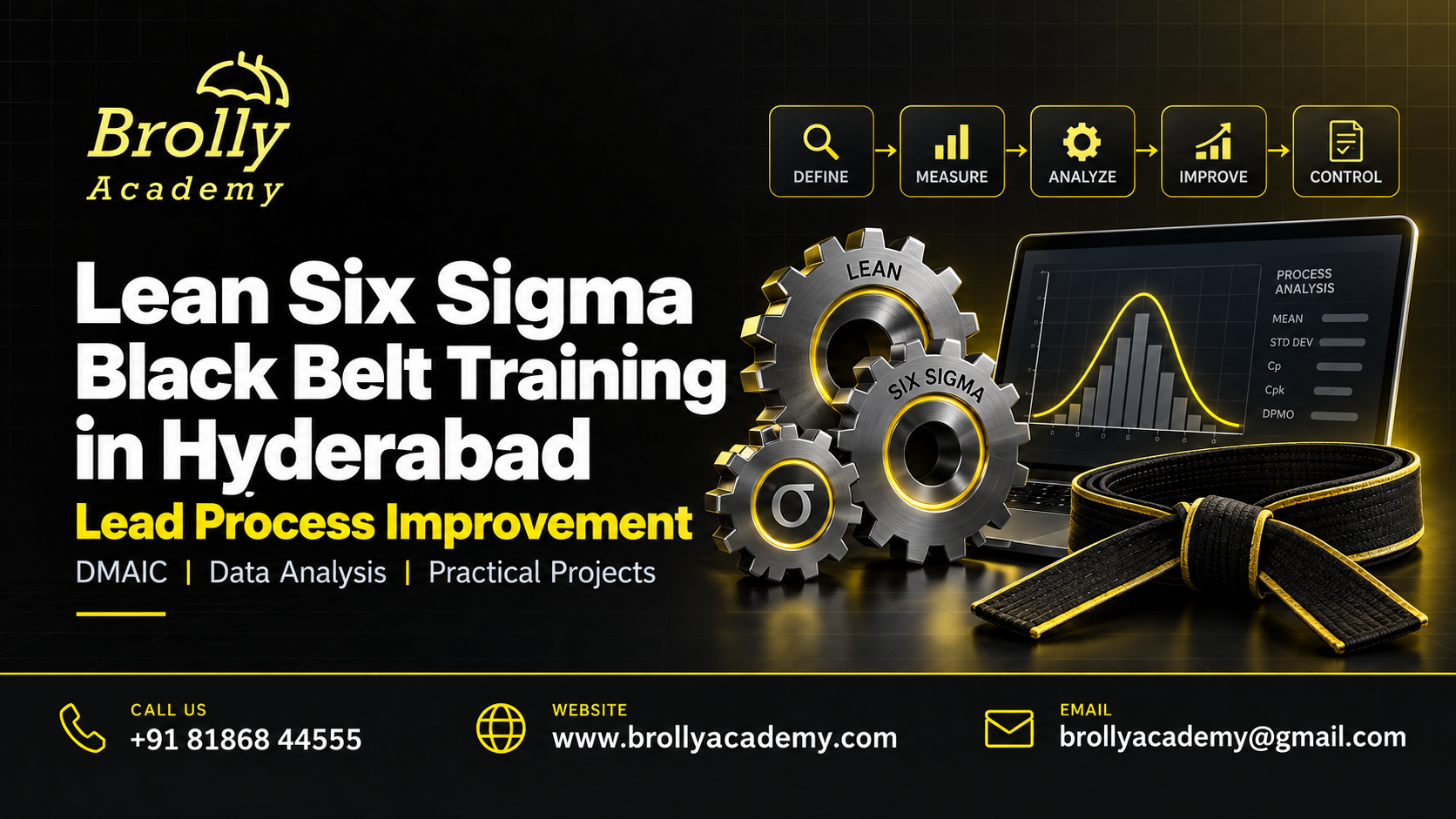
Lean Six Sigma Black Belt Training in Hyderabad
Build practical process-improvement skills with Lean Six Sigma Black Belt Training in Hyderabad at Brolly Academy. Learn DMAIC, data analysis and project leadership with Arjun Rao through 32 live hours across 4 weeks. Course fee: INR 45,999, with practical exercises, course-completion certification and certification guidance.
TrainerArjun Rao
Duration4 weeks / 32 hours
Course feeINR 45,999
Learning modesClassroom and online
Lean Six Sigma Black Belt Course in Hyderabad
Lean Six Sigma combines two useful ideas: make work flow with less waste, and reduce defects by understanding variation. A Black Belt brings these ideas together to lead improvement projects, select appropriate statistical methods and help teams make better decisions.
The 4-week course connects each topic to a practical output: a charter, measurement plan, statistical analysis, pilot or control plan. Choose classroom or live online learning and build a project story that explains the problem, evidence, action and outcome. The course leads to a Brolly Academy completion certificate, with guidance for independent certification as a separate next step.
A clear learning pathStart with the business problem, then work through measurement, analysis, improvement and control. Advanced tools should support a decision, not become an end in themselves.
An informed course choiceDiscuss your previous Six Sigma experience, statistics confidence and access to a workplace project. Ask which learning gaps need attention before starting advanced topics.
Why Choose Brolly Academy for Black Belt Training?
Build a practical understanding of process improvement through a structured course, exercises and project discussions. The aim is to help you explain a business problem, select a suitable method and turn analysis into an action a team can use.
A clear four-week learning pathFollow 10 modules across 32 instructor-led hours. Each stage connects the concepts to an output, from the first project charter to a final control plan.
Practice that supports decisionsWork through data preparation, measurement checks, statistical comparisons and pilot planning. Learn when a result is useful and when more evidence is needed.
Guidance from your trainerLearn with Arjun Rao and discuss the reasoning behind the tools. Use questions and project reviews to connect the classroom exercises to a process you understand.
Classroom and live online learningChoose the delivery mode that fits your location and work commitments. Discuss the available batch timings with our team before enrolling.
Course completion and next stepsReceive a Brolly Academy course-completion certificate after meeting the requirements, with guidance on the separate route to an independent professional credential.
Career preparationWork on your project explanation, resume and interview readiness. Present what you actually completed and measured rather than relying on a certificate alone.
Black Belt Syllabus: 10 Learning Modules
Our ten-module syllabus follows the full improvement-project lifecycle. Learn the method, practise with data and create an output at every stage, from project selection and measurement to experiments, control and a final presentation.
Module 1: Lean Six Sigma foundations and Black Belt leadership
Understand how Lean reduces waste and improves flow, while Six Sigma uses data to study variation and defects. Learn the roles of a sponsor, process owner, Green Belt and Black Belt. Connect customer needs with business goals, and distinguish a useful improvement project from a routine task. Discuss team responsibilities, ethical reporting and how to win support without blaming people. Practice output: a project-selection scorecard with a clear reason for choosing one problem.
Module 2: Define the problem with a project charter
Turn a broad complaint such as "our service is slow" into a measurable problem statement. Cover voice of the customer, critical-to-quality requirements, SIPOC, stakeholder mapping and project boundaries. Set a baseline period, target, owner and expected benefit before choosing a solution. A good charter says what is inside and outside the project. Practice output: a one-page charter and a high-level process map for an invoice, service or production workflow.
Module 3: Measure the process and check the data
Identify continuous and categorical data, write operational definitions and plan representative sampling. Study measurement-system analysis, repeatability, reproducibility and attribute agreement. Learn why a precise chart is not trustworthy when the original measurements are inconsistent. Check missing records, duplicate entries and changing definitions before calculating results. Practice output: a data-collection sheet, a measurement review and an explanation of the limits of the available data.
Module 4: Understand variation and process capability
Use histograms, box plots, descriptive statistics and probability distributions to understand how a process behaves. Separate stability from capability: a stable process can still fail customer requirements. Compare specification limits with control limits, and learn what Cp, Cpk, Pp and Ppk describe. Check assumptions before interpreting capability indices, particularly with non-normal data. Practice output: a baseline report that explains the variation and avoids claiming capability from an unstable process.
Module 5: Analyze causes with hypothesis testing
Explore Pareto charts, cause-and-effect diagrams, process stratification and the five whys, then test the suspected causes with evidence. Learn null and alternative hypotheses, confidence intervals, practical importance, Type I and Type II errors and sample-size planning. Choose suitable mean, proportion, variance or association tests for the question and data. Practice output: a short analysis showing the test choice, assumptions, result and what it does not prove.
Module 6: Build and interpret regression models
Examine relationships between a process outcome and possible drivers using correlation, simple regression and multiple regression. Read coefficients, confidence intervals and residual plots. Check whether important variables are missing and whether predictors overlap too much. A strong statistical relationship alone does not establish cause and effect. Practice output: an explanation of a fitted model in plain language, including its limitations and a sensible next validation step.
Module 7: Improve through designed experiments and Lean methods
Learn factors, levels, responses, interactions, randomization, replication and blocking in design of experiments. Compare full and fractional factorial approaches, and understand why changing one factor at a time can miss interactions. Combine evidence with practical methods such as 5S, mistake proofing, standard work and flow improvement. Test changes on a safe pilot before a wider rollout. Practice output: an experiment or pilot plan with success criteria, risks and rollback steps.
Module 8: Control results and prevent the problem returning
Select control charts according to the data type and sampling design. Distinguish unusual process signals from routine variation so that teams do not adjust a stable process unnecessarily. Develop a control plan with the metric, owner, review frequency, trigger and response. Include updated work instructions, training and a handover to the process owner. Practice output: a control plan that another team member could follow without the project leader present.
Module 9: Manage risk, change and business benefits
Use failure mode and effects analysis to discuss potential failures and prioritize action with the team. Plan stakeholder communication, resistance management and tollgate reviews. Distinguish cost reduction, cost avoidance and released capacity, and avoid counting the same benefit twice. Explore when improving an existing process through DMAIC differs from designing a new one through DMADV. Practice output: a risk register and benefit-validation note with assumptions made visible.
Module 10: Assemble a capstone and certification study plan
Bring the charter, data, analysis, pilot and control plan into one project story. Explain rejected ideas as well as the selected solution. Review what evidence supports the result and whether the gain lasted. Map your study gaps to the current body of knowledge of your chosen certification provider. Practice output: a concise project presentation and personal revision plan. A classroom exercise is not automatically an accepted professional certification project.
Discuss Your Black Belt Learning Plan
Tell us about your current role and Six Sigma experience. Request the confirmed syllabus, session hours, software requirements and next available demo.
Your DMAIC Project Roadmap
DMAIC stands for Define, Measure, Analyze, Improve and Control. Move to the next stage when you have enough evidence to make a responsible decision, not simply because a calendar week has ended.
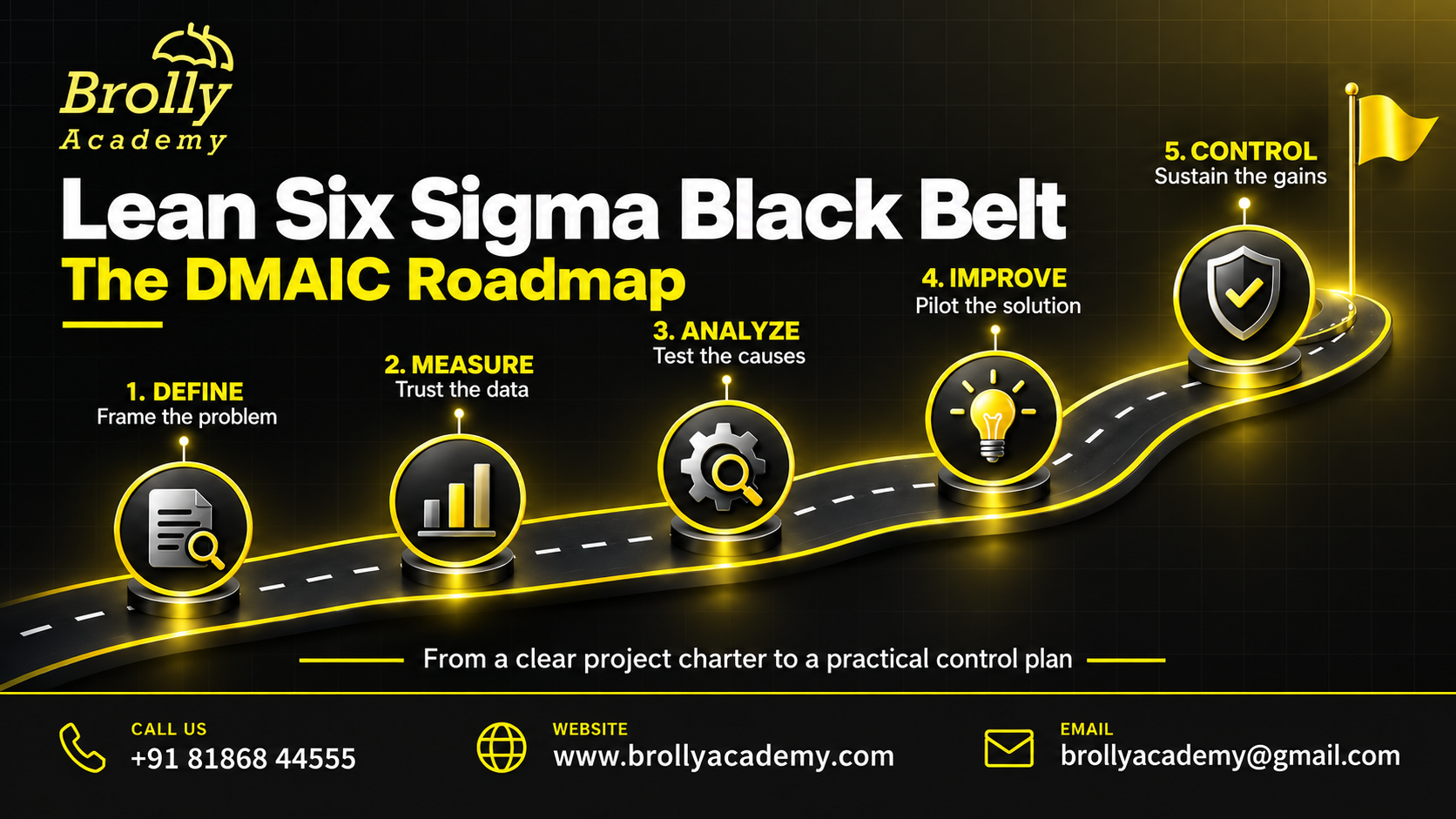
Define: agree on the problemProduce a charter, customer requirement and realistic project boundary. Confirm the owner and why solving the problem matters.
Measure: establish a trustworthy baselineDocument how the metric is collected and whether the measurements are consistent. Record the starting performance before changing the process.
Analyze: investigate likely causesLook for patterns, test explanations and separate evidence from opinion. State the limits of the analysis.
Improve: test a workable changePilot the solution, track unintended effects and compare performance fairly. Decide whether to adopt, revise or stop the change.
Control: assign ownershipDefine monitoring, response rules, updated procedures and handover responsibilities so that the gains do not disappear.
A Simple Example: Faster Work Without More Errors
Imagine an invoice team wants to reduce delays. It would be tempting to ask everyone to work faster. DMAIC starts by asking where the time is actually spent and how a late invoice is defined.
The team first records the same start and end points for every invoice. It checks whether missing supplier information, approval queues or rework explain the delay. It then pilots a standard information checklist with a small group and measures both processing time and error rate.
An improved average alone is not enough. Compare similar types of invoices, examine the spread of processing times and check whether the improvement lasts. If one group handled simpler invoices during the pilot, the comparison may be misleading. This is why a Black Belt needs judgment as well as calculations.
5 Benefits of Learning Black Belt Methods
The value of this learning is in how you investigate problems and guide action. These five benefits describe practical skills, not a promise of a job, promotion or guaranteed savings.
01Make decisions with evidenceReplace assumptions with a defined measure, a suitable analysis and a clear decision rule. Learn to explain uncertainty instead of presenting every result as certain.
02Solve the right problemUse customer needs and process data to focus effort on a meaningful problem. Avoid improving a local step while creating delays or extra work elsewhere.
03Lead cross-functional workConnect the sponsor, process owner and team around a shared objective. Build a habit of clear responsibilities, review points and respectful problem solving.
04Show practical project evidenceBuild a coherent record of how a problem was investigated and improved. A credible project explanation is more useful than a list of software commands.
05Keep improvements workingMove beyond a successful pilot to ownership, monitoring and response plans. Sustainable improvement depends on what happens after the project presentation.
Brolly Academy and Other Institutes: What to Compare
Ask every training provider the same questions. Compare written details and a demo rather than assuming that all Black Belt courses include the same certification, software or support.
Discuss with Brolly AcademyRequest the batch syllabus and contact hours.
Ask for the assigned trainer profile.
Confirm the practical exercises and project-review process.
Check tool access, total fees and certificate issuer.
Discuss your readiness and preferred schedule.
Check with any other instituteRequest the same scope in writing.
Verify the named trainer and relevant experience.
Ask what you complete yourself, not only watch.
Separate course fees from exam and software costs.
Check refund, rescheduling and support terms.
A provider calling its course "aligned" to a body of knowledge does not by itself prove accreditation, include an exam voucher or guarantee certification. Verify any affiliation directly with the named certification body.
Meet Your Black Belt Trainer
Learn with Arjun Rao, your Lean Six Sigma Black Belt trainer at Brolly Academy. The sessions connect statistical methods with practical process-improvement questions, helping you understand both the calculation and the decision behind it.
Arjun RaoLean Six Sigma Black Belt Trainer
Guides learners through the DMAIC learning path, from defining a problem to presenting an improvement project and control plan.
Practical learning and project reviewDiscuss your project scope, data definitions, choice of analysis and improvement plan. Bring questions about your calculations and learn how to explain the result to a process owner.
Teaching focusDMAIC, measurement-system analysis, hypothesis testing, regression, design of experiments and control charts. Join a demo to experience the teaching approach and discuss your learning goals.
Skills You Will Gain from Black Belt Training
Black Belt skills combine careful analysis with clear communication. By practising the course activities, you build the ability to choose an appropriate tool, explain its assumptions and discuss the next business decision.
Project scopingConvert a broad complaint into a measurable problem, scope boundary, customer requirement and realistic project objective.
Process mappingUse SIPOC and workflow maps to understand suppliers, inputs, handoffs, queues and the steps that matter to the customer.
Measurement-system thinkingDefine a metric consistently and examine whether measurements are repeatable before treating the dataset as reliable evidence.
Statistical interpretationRead distributions, confidence intervals and test results. Separate statistical significance from a change that matters in practice.
Root-cause investigationCombine process knowledge, stratification and suitable tests to examine suspected causes without confusing correlation with proof.
Regression and experimentsExplore the drivers of a process result, check model assumptions and plan experiments that can reveal interactions between factors.
Lean improvementUse flow analysis, standard work, mistake proofing and waste reduction to improve how work moves through the process.
Control and handoverSelect sensible monitoring measures and response rules, then define who owns the improved process after the project ends.
Project communicationPresent the baseline, evidence, proposed change, risks and verified result in language that sponsors and process owners can understand.
Statistics, Minitab and Spreadsheet Practice
Black Belt analysis requires more than knowing which software button to click. You need to select an appropriate method, inspect assumptions and explain what the output means for the process.
Data preparationOrganize columns, units, timestamps and defect definitions. Keep the source data and document exclusions so another person can reproduce the work.
Statistical analysisPractice measurement studies, capability, hypothesis testing, regression, experiments and control charts. Confirm the software package and access arrangement for your batch.
Business communicationTranslate technical output into a decision, action and limitation. Build a short report that a process owner can understand and use.
For statistical methods, consult the NIST/SEMATECH statistical handbook. To strengthen spreadsheet preparation, explore Advanced Excel Training in Hyderabad. Tool licenses and any extra charges should be confirmed before enrolment.
Practical Black Belt Project Examples
These are illustrative learning scenarios, not claims about completed Brolly client projects. Use synthetic or properly anonymized data, and agree the project scope with the trainer before starting.
Example 1Reduce invoice-processing delaysUse a fictional invoice dataset to separate waiting time, rework and approval delays. Define the start and finish of the process, compare transaction types and propose a small pilot. Report cycle time alongside accuracy so that speed does not hide new errors.
Example 2Improve service-ticket resolutionStudy repeat contacts, handoffs and resolution time using anonymized service data. Compare similar ticket categories before judging teams. The project should show how a routing or knowledge-base change affects both response time and the customer outcome.
Example 3Reduce manufacturing reworkInvestigate a repeated defect using a safe teaching dataset. Check the measurement method, review variation by machine or shift and test a suspected driver. Include a practical control plan; do not label a simulated result as a real factory saving.
Example 4Improve order fulfilmentMap the journey from order receipt to dispatch. Explore missing information, inventory mismatches and queue time. Define on-time delivery consistently and examine whether a process change improves the whole workflow rather than only one department.
A useful project file contains a charter, operational definitions, baseline, analysis, pilot evidence, control plan and a short reflection. Explain how the result was verified, what changed outside the project and who owns the new process. If you report savings, show the assumptions and who validated them.
Modes of Lean Six Sigma Black Belt Training
The course follows the same Black Belt learning objectives in classroom and live online modes. The program provides 32 live hours over 4 weeks, with additional independent practice and project work.
Classroom training in HyderabadAttend instructor-led sessions at Brolly Academy and discuss exercises face to face. The centre is near JNTU Metro Station, with access from Kukatpally, KPHB, Nizampet and nearby areas.
Live online trainingJoin interactive sessions remotely, follow demonstrations and discuss your analysis with the trainer. Arrange a quiet workspace, a stable internet connection and the software specified for the batch.
Corporate training enquiriesDiscuss a team program around a shared process problem, business priorities and approved data. Corporate scope, scheduling and fees are quoted separately from the individual course fee.
Course Fees, Duration and Batch Options
The Lean Six Sigma Black Belt course fee at Brolly Academy is INR 45,999. The program includes 32 instructor-led hours across 4 weeks, practical learning activities, a course-completion certificate and guidance on independent certification pathways.
Course fee: INR 45,999Learn the 10-module Black Belt syllabus through instructor-led sessions and practical exercises. Contact our team for the payment schedule, applicable taxes and a written breakdown of course inclusions.
Duration: 32 live hoursComplete 4 weeks of training with 8 instructor-led hours per week. Set aside additional time for independent practice and project work. Contact the team for the next batch dates and available session timings.
Completion certificate and guidanceReceive a Brolly Academy course-completion certificate after meeting the course requirements. Get guidance on the syllabus, eligibility and preparation pathway for independent Black Belt certification. External exams are separate.
Book a free demo to discuss the course before enrolling. Ask about payment options, software access, applicable taxes, refund and rescheduling terms. Independent certification examination fees and software licenses are separate unless included in your written enrolment agreement.
Placement Support and Career Preparation
Brolly Academy supports your preparation for quality, process-analysis and continuous-improvement opportunities. The focus is on presenting your skills clearly and explaining evidence from your work. Placement assistance is not a job or salary guarantee.
Resume preparationDescribe your actual responsibilities, tools and project contribution. Turn vague claims into clear examples and identify the evidence behind any numerical result.
Project presentationPrepare a short DMAIC project story covering the problem, data, analysis, change and control plan. Explain what you did personally and what the team contributed.
Technical interview practicePractise questions about measurement quality, capability, hypothesis tests, regression, experiments and control charts. Explain why you selected a method instead of memorising definitions.
Business communicationDiscuss project priorities, trade-offs, risks and benefits in plain language. Practise explaining a statistical result to a manager who does not use the same software.
Role selectionCompare quality analyst, improvement specialist and operational-excellence roles against your current industry experience. Use job requirements to identify your next learning priorities.
Application readinessPrepare your resume, project summary and interview examples together. Track applications carefully and tailor the evidence you share to the responsibilities of each role.
Student Reviews and Learning Community
Explore feedback about studying at Brolly Academy and use a demo to assess the Black Belt teaching approach. Academy-wide reviews cover different courses; they should not be treated as Black Belt-specific completion or placement results.
Read Brolly Academy reviewsExplore learner reviews to understand how students describe the academy. Compare the feedback with what matters to you: teaching clarity, practical work, support and communication.
Visit the academy or join a demoMeet the team, ask questions about the course and discuss how the 32-hour schedule fits your goals. Contact Brolly Academy for the next available demo and batch details.
Learn with a Black Belt Student Community
Discuss and practiseCompare approaches to a process problem with fellow learners. Explain why a metric, test or control method fits, and listen to alternative interpretations.
Share learning resources responsiblyUse the course worksheets and official statistical references to revise. Share only synthetic, public or properly authorised data, never confidential customer or employer information.
Build professional communicationPresent your project thinking, ask focused questions and respond constructively to feedback. These habits support both improvement work and interview conversations.
Who Should Join and What Should You Know?
This learning path is most useful when you can connect the tools to a real process. Green Belt-level knowledge, basic statistics and spreadsheet confidence are helpful. Training admission and independent certification eligibility are separate decisions.
Quality and operations professionalsExplore recurring defects, delays, rework and inconsistent service. Bring a clear example from your industry, using only information you are allowed to share.
Green Belts and process analystsDevelop stronger analysis, project leadership and stakeholder communication. Be prepared to explain why a method fits the problem and what its assumptions are.
Project and team leadersConnect improvement priorities with customer needs and business value. Learn to work with process owners and specialists across functions.
Freshers and career changersFirst assess your familiarity with process mapping, averages, variation and data tables. A foundation-first route can be more useful than rushing into advanced statistics.
For complementary requirements and stakeholder skills, explore Business Analyst Training in Hyderabad. It supports a different role and is not a substitute for Black Belt statistical and project practice.
Career Applications in Hyderabad
Lean Six Sigma skills can support improvement work in manufacturing, service operations, healthcare administration, finance operations, logistics and technology-enabled business processes. The relevant role depends on your domain experience and demonstrated project results.
Quality and continuous improvementInvestigate recurring problems, coordinate corrective work and monitor whether improvements remain effective.
Operational excellenceConnect customer needs, process performance and business priorities across teams and locations.
Process and business analysisStudy workflows, define measures and communicate changes. Combine analytical work with stakeholder understanding.
Use the career-support activities to strengthen your resume, project presentation and interview preparation. Employers assess industry experience, leadership and evidence of results alongside qualifications. Placement assistance does not guarantee a job, salary increase or promotion.
For reporting improvement results, Power BI Training in Hyderabad can complement dashboard skills. For broader delivery planning, explore PMP Certification Training; it has a different focus and separate eligibility requirements.
Black Belt Salary and Career Progression in Hyderabad
There is no single salary attached to a Black Belt course. Pay depends on the role, industry, relevant experience, responsibilities and evidence of successful improvement work. Compare like-for-like job offers rather than applying a national or overseas average to every Hyderabad role.
Early-career rolesLook at quality, process and operations-analyst requirements. Focus on a solid foundation, careful use of data and a clear explanation of the practice work you completed.
Experienced specialistsConnect your domain experience with project leadership and measurable results. Be ready to explain how the benefit was calculated, verified and maintained.
Leadership and consultingBroader roles may include project selection, stakeholder management, coaching and cross-functional delivery. A credential alone does not establish readiness for these responsibilities.
When comparing salary research, check the year, geography, job definition, respondent count and whether the figure is a mean or median. The ASQ salary-survey definitions explain these distinctions. Overseas survey figures are not Hyderabad salary promises.
Course-Completion Certificate and Certification Guidance
Brolly Academy provides a course-completion certificate after you meet the course requirements, along with guidance on independent Black Belt certification pathways. The completion certificate records your training; it is not an ASQ, IASSC or PeopleCert professional credential. Confirm the attendance, assessment and project requirements for your batch before enrolling.
ASQ Certified Six Sigma Black BeltASQ lists project and experience conditions: three years of relevant paid work experience plus one completed project with a signed affidavit, or two completed projects with signed affidavits. Check the official ASQ CSSBB requirements before planning an application.
PeopleCert / IASSC Black BeltThe IASSC Black Belt exam lists no formal prerequisites, while recommending relevant preparation and practical experience. Check the official PeopleCert ICBB page and IASSC certification guidance for current exam and renewal details.
Certification guidance covers finding the correct official syllabus, understanding eligibility and planning your next preparation steps. The external issuing body alone decides eligibility and awards its credential. No ASQ, IASSC or PeopleCert accreditation, guaranteed exam pass or included external exam voucher is claimed.
Industry Applications and Black Belt Opportunities
Lean Six Sigma can be applied wherever a repeatable process has defects, delays, rework or inconsistent results. The business problem and your domain knowledge should guide the choice of tools.
Finance and shared servicesExplore invoice accuracy, approval delays, repeat queries and reconciliations. Define the transaction types before comparing cycle time or error rates.
Manufacturing and supply chainsInvestigate variation, defects, changeover time, rework and fulfilment delays. Check measurement reliability and consider the effect on the whole process.
Technology and service operationsStudy handoffs, repeat contacts, ticket resolution and workflow bottlenecks. Balance speed with quality so a faster step does not create new failures elsewhere.
Explore quality and process-improvement opportunities through the official ASQ Career Center. Check each role's location, responsibilities, experience requirements and current availability. Listings may be outside Hyderabad; this resource is not a claim of a Brolly hiring partnership or guaranteed vacancy.
Free Project-Planning Worksheets
Use these editable worksheets to organize an improvement idea and compare training options. They are learning aids, not an official certification syllabus or a guarantee that a project meets an issuer's requirements.
Download Project Charter (CSV) Download Control Plan (CSV) Download Course Checklist (CSV)Talk to Brolly Academy in Hyderabad
Visit the academy near JNTU Metro Station to discuss your learning goals. The centre address is Metro Pillar No. A689, Dr Atmaram Estates, 3rd Floor, Nizampet X Roads, Hyderabad 500072. Confirm the Black Belt batch venue and availability before travelling.
Learners in Kukatpally, KPHB, Nizampet, Miyapur, Madhapur and other parts of Hyderabad can contact Brolly Academy to ask about current training options. For an organizational enquiry, see corporate training.
Get Directions Call +91 81868 44555Other Relevant Courses at Brolly Academy
Choose complementary learning based on the skills your role needs. These courses serve different goals and are not required substitutes for Black Belt project practice.
Advanced Excel TrainingStrengthen spreadsheet preparation, formulas and reporting skills for working with process data and reviewing results.
Power BI TrainingDevelop dashboard and reporting skills to communicate process measures, trends and improvement outcomes.
Business Analyst TrainingBuild requirements, stakeholder and business-process analysis skills that complement an improvement project.
PMP Certification TrainingExplore broader project-delivery planning and management. PMP certification has its own eligibility and examination requirements.
Lean Six Sigma Black Belt Training FAQs
What is Lean Six Sigma Black Belt training?
It is advanced learning in process improvement, statistical analysis and project leadership. You study how to define a business problem, measure performance, investigate causes, test improvements and maintain results. Black Belt work also involves guiding teams and explaining decisions to stakeholders.
Who should consider a Black Belt course in Hyderabad?
Quality professionals, operations managers, process analysts, project managers and experienced Green Belts may find it useful when their work involves improving a process. Choose the course based on your current skills and project responsibilities, not only your job title.
Do I need a Green Belt certificate first?
There is no single rule shared by every training institute and certification provider. Green Belt-level understanding is a useful learning foundation, but formal exam eligibility depends on the credential. Discuss your background with Brolly Academy and check the relevant provider before applying.
Can a fresher learn Black Belt topics?
A fresher can study the concepts, but advanced statistics and leading a workplace project can be difficult without experience. Start with process mapping, spreadsheet skills and basic statistics, then assess readiness. Completing training does not automatically satisfy an experience-based certification requirement.
What is the course fee at Brolly Academy?
The Lean Six Sigma Black Belt course fee at Brolly Academy is INR 45,999. The program includes 32 instructor-led hours, practical learning, a course-completion certificate and independent-certification guidance. Ask for the payment schedule and applicable taxes. External exams and software licenses are separate unless your written enrolment agreement includes them.
How long does Black Belt training take?
The course runs for 4 weeks with 32 instructor-led hours, scheduled as 8 live hours per week. Independent study, statistical exercises and project work are additional. Contact Brolly Academy for the next batch dates and available session timings.
Can I attend online or in a classroom?
Yes. Choose classroom training in Hyderabad or live online sessions. Both follow the Black Belt syllabus and the 32-hour instructor-led learning plan. Contact our team to select the available batch and discuss the session timings.
Which certificate and certification guidance are included?
Brolly Academy offers a course-completion certificate and guidance on independent Black Belt certification pathways. The academy certificate is not an ASQ, IASSC or PeopleCert credential. External eligibility checks, applications and exams remain subject to the issuing body, and no external exam voucher or guaranteed pass is implied.
What is the difference between Green Belt and Black Belt?
Green Belt learning commonly supports improvement work within a defined area. Black Belt learning goes deeper into statistical analysis, cross-functional project leadership and coaching. The exact syllabus and eligibility still depend on the provider, so compare the actual learning outcomes rather than the belt name alone.
Do I need programming or advanced mathematics?
Programming is not central to every Black Belt course. You do need to work carefully with numbers, percentages, graphs and statistical reasoning. Software can calculate a result, but you must understand the question, assumptions and business meaning. Ask which tools the batch uses.
Will I learn Minitab?
Minitab is commonly used for Six Sigma analysis, and the learning outline includes the types of statistical work it supports. Confirm the software used in your batch, the lab exercises and whether a license or trial is included. A software license is not implied by a course enquiry.
Is a practice project enough for certification?
Not necessarily. A simulated classroom exercise helps you learn, but a certification provider may require workplace evidence, a signed affidavit or other conditions. Read the current rules before deciding which project to undertake and who needs to verify it.
What jobs use Lean Six Sigma Black Belt skills?
Relevant work can include quality improvement, operational excellence, continuous improvement, process analysis and transformation projects. Employers also assess industry experience, leadership and evidence of results. Training alone does not guarantee a role, salary increase or promotion.
How should I choose between Brolly Academy and another institute?
Compare the confirmed syllabus, trainer experience, hands-on practice, project-review process, software access, total cost and certificate issuer. Ask each provider the same questions and compare written answers. Avoid relying only on discounts or a promise to pass an exam.
How do I enquire about a demo and the next batch?
Use the demo enquiry form below, call +91 81868 44555 or send a WhatsApp message. Share your current role, experience with Six Sigma and preferred schedule so the team can discuss a suitable starting point and current availability.
Request a Free Demo and Course Details
Share your details so the Brolly Academy team can contact you about availability. Ask about the trainer, prerequisites, syllabus, schedule and total cost before deciding to enrol.
Your details are used to respond to this course enquiry. Read our Privacy Policy.