Generative AI Roadmap 2026: Your Step-by-Step Path to Learn GenAI
Learning Path 2026
The exact order to learn generative AI, phase by phase, with the skills, tools and projects that take you from beginner to job ready.
A generative AI roadmap is a step-by-step plan to learn generative AI, from the basics to building real applications. It starts with Python and maths, then machine learning and deep learning, then core topics like transformers, large language models, prompt engineering, RAG, fine-tuning and AI agents, and ends with deployment and portfolio projects. Most beginners can follow it in three to six months.

Share
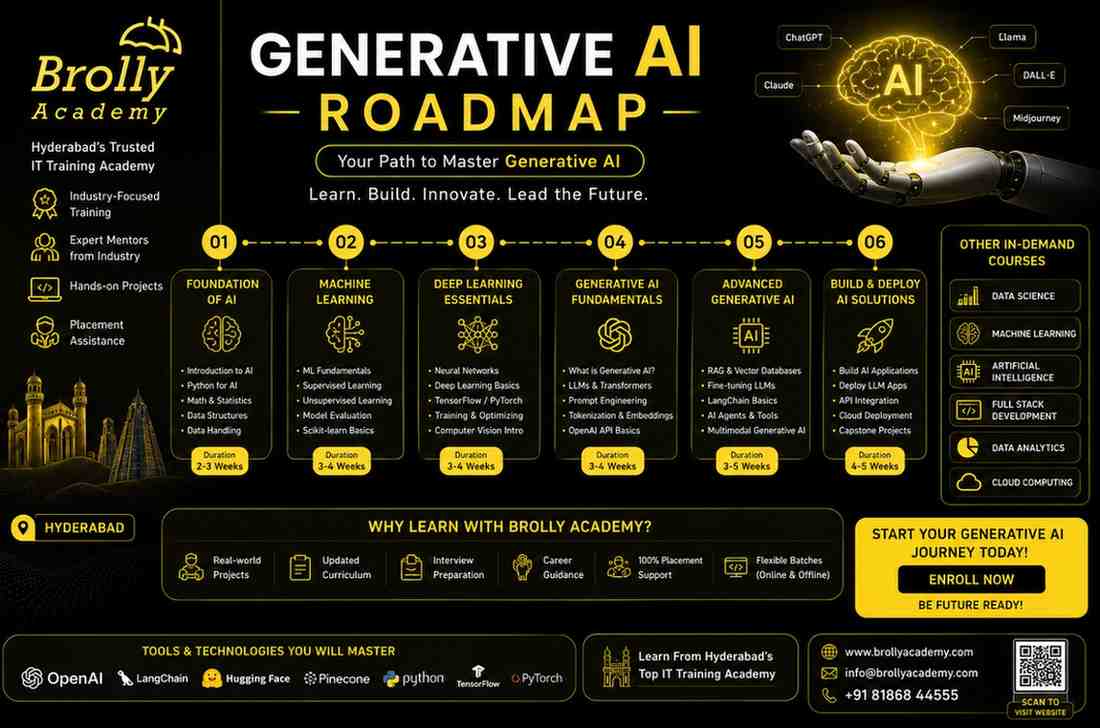
Table of Contents
What Is a Generative AI Roadmap?
A generative AI roadmap is simply the right order to learn things, so you never feel lost.
Generative AI has many topics, like Python, transformers, large language models, RAG and AI agents. Without a plan, beginners jump between random tutorials and end up with gaps. A roadmap fixes that. It tells you what to learn first, what comes next, and what to build at each step.
This guide gives you a clear, six-phase generative AI roadmap for 2026. It works whether you are a student, a working professional or a career switcher. If you are brand new, it helps to first see some real generative AI examples, then come back and follow the path below.
Why follow a roadmap at all? Because generative AI is huge, and it is easy to waste months on random videos that do not connect. A roadmap turns a confusing field into a simple, ordered path. You always know what you are learning, why it matters, and what comes next.
What You Need Before You Start
The good news is you do not need much to begin. A good roadmap meets you where you are.
- Coding. None needed to start. Python is taught from zero in Phase 1.
- Maths. School level maths is enough. The extra bits, like basic linear algebra and statistics, are taught along the way.
- Time. Around 8 to 12 hours a week lets most people finish in three to six months.
- A computer and internet. That is it. Most tools are free or have free tiers.
If you can give steady time each week, you can follow this roadmap. The biggest thing that matters is not your background, it is finishing each phase with a small project.
Who This Roadmap Is For
This generative AI roadmap works for many kinds of learners. You do not need a special background to follow it.
- Students. Build skills and projects that make your resume stand out before you graduate.
- Working professionals. Add generative AI to your current role, whether you are in software, data or another field.
- Career switchers. Move into AI from a different career, step by step, without quitting first.
- Non-coders. Start with Python from zero and grow into a builder at your own pace.
Wherever you are starting from, the order stays the same. Follow the phases, finish the projects, and you will get there.
The Generative AI Roadmap at a Glance
The generative AI roadmap has six phases. Each one builds on the last, so follow them in order.
- Python and maths foundations
- Machine learning and deep learning
- Core generative AI: transformers, LLMs and prompt engineering
- Building real systems: RAG, vector databases and fine-tuning
- AI agents and agentic AI
- Deployment, projects and your portfolio
Here is the same path with a rough time for each phase, so you can plan your study.
| Phase | Focus | Typical Time |
|---|---|---|
| 1. Foundations | Python, maths, data handling | 4 to 6 weeks |
| 2. ML and Deep Learning | Machine learning, neural networks | 4 to 6 weeks |
| 3. Core Generative AI | Transformers, LLMs, prompt engineering | 4 to 6 weeks |
| 4. Real Systems | RAG, vector databases, fine-tuning | 3 to 5 weeks |
| 5. AI Agents | Agentic AI, tools, MCP | 2 to 3 weeks |
| 6. Deployment and Projects | LLMOps, portfolio building | 3 to 4 weeks |
Notice how each phase builds on the one before. You cannot skip ahead, because Phase 4 needs the language models from Phase 3, and Phase 3 needs the basics from Phases 1 and 2.
Phase 1: Foundations, Python, Maths and Data
Every AI tool is built with code, so this is where you start. The goal is to get comfortable with Python and a little maths.
- Python. Variables, loops, functions, object-oriented programming (OOP), error handling, and working with APIs and JSON.
- Data tools. NumPy and Pandas, used to handle and clean data.
- A little maths. Basic linear algebra, probability and statistics. Just enough to understand how models work.
You can learn the basics from free resources like DeepLearning.AI and official docs. Keep it light and practical.
Do not rush this phase. Strong Python and a little maths make everything after it easier.
Build this: a small Python program that reads a data file and prints a simple summary. It proves you can handle data.
Phase 2: Machine Learning and Deep Learning
Generative AI sits on top of machine learning and deep learning, so you need the basics of both. If you want to see how it differs from older AI, compare generative AI and predictive AI.
- Machine learning. How models learn from data, common methods like classification, and key ideas like overfitting and the bias-variance balance.
- Deep learning. Neural networks and how they power modern AI, including layers, activation functions and backpropagation.
- Building blocks. CNNs and RNNs, then the move toward transformers.
You do not need to master every algorithm. Aim to understand the ideas well enough to move on to large language models with confidence.
Build this: a simple model that predicts something from a small dataset, like house prices. It shows you understand the training loop.
Phase 3: Core Generative AI, Transformers, LLMs and Prompt Engineering
This is the heart of the roadmap. Here you learn the technology behind tools like ChatGPT and Gemini.
- Transformers. The design that powers almost every modern AI model.
- Large language models. How they work, how they are trained with human feedback (RLHF), and how to use models like GPT, Llama and Mistral.
- Prompt engineering. Writing instructions that get great results, including context engineering.
- Embeddings. How words and sentences become numbers, so an AI can compare meaning. This idea quietly powers search and RAG.
Generative AI is not only about text. This phase also introduces the generative AI models that create images, behind tools like Midjourney and Stable Diffusion.
Open models are easy to try on Hugging Face. By the end of this phase, you can talk to models and shape their answers.
Build this: a simple chatbot that uses a large language model and a few smart prompts to answer questions.
Phase 4: Building Real Systems, RAG, Vector Databases and Fine-Tuning
This phase is where learners become hireable. You move from chatting with models to building real apps.
- RAG. Retrieval augmented generation lets an AI look up facts before it answers, like an open-book test.
- LangChain. A toolkit that joins models, data and tools into a working app, with LangSmith to test and debug it.
- LlamaIndex. A tool for indexing and querying your own documents, often used alongside LangChain.
- Vector databases. Tools like Pinecone and Chroma that store and search AI data fast.
- Chunking. Splitting documents into smart pieces, so the AI can find the right part to answer from.
- Fine-tuning. Adapting a ready-made model to your own data, with light methods like LoRA and QLoRA.
These are the skills companies ask for most. See how they fit the full path in our generative AI learning path.
Build this: a document assistant that uses RAG to answer questions from your own files. This is a strong portfolio project.
Phase 5: AI Agents and Agentic AI
This is the newest and fastest growing area in 2026, and most older roadmaps skip it. An AI agent can plan, use tools and finish tasks on its own.
- What agents do. They break a goal into steps, use tools, and act, not just chat.
- Key ideas. The Model Context Protocol (MCP), agent memory, and thinking patterns like ReAct.
- Frameworks. Building multi-agent systems with tools like LangGraph and CrewAI.
Agentic AI is where a lot of new jobs are being created, so learning it now puts you ahead.
Build this: a small agent that can search the web and write a short summary on its own.
Phase 6: Deployment, Projects and Your Portfolio
Building an AI is one thing. Running it for real users and showing your work is what gets you hired.
- Deployment basics. Putting your app online so others can use it.
- LLMOps. Keeping AI fast, safe and low cost, and watching it so it keeps working.
- Cloud. Running models on platforms like Azure OpenAI and Amazon Bedrock.
- Portfolio. Three or four real projects, shared on GitHub, that you can show in interviews.
Your projects matter more than any single certificate. For more ideas, see our generative AI projects.
Build this: take your best project, deploy it online, and write a short post explaining how you built it.
How Long Does the Generative AI Roadmap Take?
With steady effort of around 8 to 12 hours a week, most beginners finish the full roadmap in three to six months.
- Foundations (Phases 1 to 2). About 8 to 12 weeks to get comfortable with Python, maths and machine learning.
- Core generative AI (Phase 3). About 4 to 6 weeks for transformers, LLMs and prompt engineering.
- Advanced and real-world (Phases 4 to 6). About 8 to 12 weeks for RAG, agents, deployment and projects.
If you already know Python or machine learning, you can move faster and skip ahead. The timeline is a guide, not a rule.
Common Mistakes to Avoid
A few simple mistakes slow most beginners down. Knowing them helps you move faster.
- Jumping to tools too early. Learning a tool before the basics leaves gaps. Follow the order.
- Tutorial hopping. Watching endless videos without building anything. Stop and build instead.
- Skipping projects. Projects are what prove your skill. Finish one at the end of each phase.
- Ignoring deployment. Many learners can build but never ship. Learn to put your work online.
Tip. The fastest learners are not the ones who watch the most videos. They are the ones who build the most projects.
Best Resources to Learn
You do not need to pay for everything. A mix of free and paid resources covers the whole roadmap.
- Foundations. The Google Machine Learning Crash Course and DeepLearning.AI.
- Models and practice. Hugging Face for open models, datasets and free hands-on courses.
- Official docs. Microsoft Learn and provider docs.
- Free practice. Kaggle and fast.ai.
- Guided learning. Brolly Academy covers this full roadmap with live projects and placement support.
Our generative AI course follows this exact roadmap, phase by phase.
Careers After the Roadmap
Finishing this roadmap opens some of the best paid roles in tech. A NASSCOM and Deloitte report expects India’s AI talent pool to grow to over 1.25 million by 2027.
- Roles. Generative AI Engineer, LLM Engineer, Prompt Engineer, AI Engineer and Data Scientist.
- Salary. Indicative pay in India starts around 6 to 12 LPA for freshers and rises to 30 LPA or more with experience.
- Freshers welcome. A strong portfolio of projects often gets you hired faster than expected.
When you start applying, prepare with common generative AI interview questions.
Certifications That Help
A certification is not required, but it helps you prove your skills to an employer.
- Microsoft. Azure AI Fundamentals (AI-900) and Azure AI Engineer (AI-102).
- AWS. The AWS Certified AI Practitioner, a good entry point.
- Google Cloud and Databricks. Google's generative AI and Vertex AI paths, and the Databricks Generative AI Engineer Associate.
A certification works best next to real projects. Your portfolio still matters more than any single exam.
Download the Generative AI Roadmap PDF
Want this roadmap to keep and follow at your own pace? You can download the full generative AI roadmap as a PDF.
Print it, save it to your phone, and tick off each phase as you go.
Get the full roadmap as a PDF you can keep.
Frequently Asked Questions
How do I start learning generative AI?
Start with Python and basic maths, then machine learning and deep learning, then transformers and large language models, then RAG, fine-tuning and agents. Build a small project at each step.
How long does it take to learn generative AI?
Most beginners can follow a generative AI roadmap in three to six months with steady effort. Foundations take four to six weeks, core generative AI another four to six weeks, and advanced topics a few more weeks.
What is the roadmap to learn generative AI?
The roadmap has six phases: Python and maths, machine learning and deep learning, core generative AI, building real systems (RAG, vector databases, fine-tuning), AI agents, and deployment with projects.
Do I need maths to learn generative AI?
You only need school level maths to begin. A good roadmap teaches the extra maths you need, like basic linear algebra, probability and statistics, along the way.
Can a beginner learn generative AI?
Yes. A clear roadmap starts with Python from zero and builds step by step. Hands-on projects are the key to learning fast.
Is Python required for generative AI?
Yes. Python is the main language for generative AI, used for data, model work and building apps. A good roadmap teaches Python from the basics.
What should I learn first in generative AI?
Learn Python first, then the basics of machine learning. These give you the base to understand deep learning, transformers and large language models later.
Is there a generative AI roadmap PDF?
Yes, a downloadable generative AI roadmap PDF helps you plan and track your progress. It lists each phase, the skills, the tools and a project for each step.
Can I learn generative AI without a degree?
Yes. Employers care most about real skills and a strong project portfolio. If you can build chatbots, RAG apps and agents, your projects speak louder than any certificate.
Can I learn generative AI on my own?
Yes, you can self study generative AI using free resources and this roadmap. A guided course helps if you want structure, feedback and mentorship.
Is generative AI hard to learn?
Generative AI is easier when you follow a roadmap. The order matters more than raw difficulty, even for complete beginners.
What programming language is best for generative AI?
Python is the best and most used language for generative AI. Almost every tool, library and framework supports Python.
Do I need to know machine learning before generative AI?
You need the basics of machine learning, not deep expertise. The roadmap covers these basics in Phase 2 before the generative AI topics.
What is the difference between AI, machine learning and generative AI?
AI is the broad field of smart machines. Machine learning is a part of AI where systems learn from data. Generative AI is a newer branch that creates new content like text, images and code.
What are the prerequisites for learning generative AI?
You need basic computer skills and a willingness to learn. No coding or advanced maths is required to start. Around 8 to 12 hours a week of study is enough.
How much maths is needed for generative AI?
Only a small amount. Basic linear algebra, probability and statistics are enough for most generative AI work, and a good roadmap teaches them as you go.
What tools should I learn for generative AI?
Key tools are Python, PyTorch or TensorFlow, Hugging Face, LangChain, LlamaIndex, a vector database like Pinecone or Chroma, and cloud platforms like Azure OpenAI or Amazon Bedrock.
What is RAG in the generative AI roadmap?
RAG, or retrieval augmented generation, lets an AI look up information before it answers. It makes answers more accurate and current, and is covered in Phase 4.
What are AI agents in generative AI?
AI agents are systems that can plan, use tools and finish tasks on their own, not just chat. The roadmap covers agents, MCP and multi-agent frameworks in Phase 5.
Should I learn LLMs or diffusion models first?
Learn large language models first. Most generative AI jobs and apps are built around LLMs, RAG and agents.
How many projects should I build to learn generative AI?
Aim for at least three to four solid projects. A chatbot, a RAG document assistant, a fine-tuned model and a small AI agent make a strong portfolio.
Can I learn generative AI in one month?
One month is enough to learn the basics and build a simple project, but not the full roadmap. Becoming job ready usually takes three to six months.
Is generative AI worth learning in 2026?
Yes. Generative AI is one of the most in-demand skills in 2026, with demand running ahead of supply across software, finance, healthcare and more.
What jobs can I get after learning generative AI?
You can target roles like Generative AI Engineer, LLM Engineer, Prompt Engineer, AI Engineer and Data Scientist.
What is the salary after learning generative AI?
In India, generative AI roles often start around 6 to 12 LPA for freshers and rise to 30 LPA or more with experience.
Do I need a GPU to learn generative AI?
No. Most learning and projects can be done with free cloud notebooks and model APIs. A GPU only helps for heavy training.
What are the best free resources to learn generative AI?
Great free resources include the Google Machine Learning Crash Course, DeepLearning.AI short courses, Hugging Face courses and Microsoft Learn.
What comes after the generative AI roadmap?
Keep building harder projects, specialise in an area like agents or fine-tuning, and apply for roles. Stay current by following new models and tools.
Key Takeaways
- A generative AI roadmap is the right order to learn skills, so you never feel lost.
- It has six phases, from Python and maths to RAG, AI agents, deployment and projects.
- You can start with no coding and only school level maths.
- Most beginners finish in three to six months with steady weekly effort.
- Building a project at the end of each phase is what makes you job ready.
Follow This Generative AI Roadmap With Expert Guidance
Learn every phase with experienced trainers, live projects and placement support. Turn this roadmap into real, job ready skills.

Brolly Academy Team
AI, Data Science and Software Training Experts. 10+ Years of Training Experience.
This roadmap is developed by Brolly Academy’s AI trainers and reviewed by founder and lead trainer Ravi Varma, who brings over 15 years of experience in IT and technology training.