Applications Of AI In Education
Overview
- Artificial Intelligence (AI) is revolutionizing the education industry by transforming how students learn, how teachers teach, and how institutions manage learning environments.
- AI-driven technologies—such as adaptive learning systems, personalized tutoring platforms, intelligent content creation tools, and automated assessments—are making education more efficient, engaging, and accessible for learners across the world.
- With AI-powered personalization, students receive customized learning paths based on their strengths, weaknesses, and pace, helping them understand complex topics more easily.
- Tools like AI tutors, chatbots, and virtual teaching assistants provide instant doubt clarification, round-the-clock support, and guided learning—enhancing student confidence and outcomes.
- In classrooms, AI helps educators by automating administrative tasks, grading assignments faster, analyzing student performance data, and generating insights that support smarter teaching decisions.
- AI also powers smart content, including auto-generated quizzes, interactive lessons, simulations, and immersive learning experiences that make subjects more engaging.
- For institutions, AI improves school management, student monitoring, curriculum planning, and digital learning infrastructure, enabling smoother operations and higher educational quality.
- In higher education and professional training, AI supports career guidance, skill assessments, and personalized upskilling, preparing students for future job markets.
- Overall, the applications of AI in education are reshaping academic landscapes by promoting equity, efficiency, personalization, and innovation.
- As AI technology continues to advance, it will play an even more crucial role in delivering smarter, data-driven, and future-ready learning experiences for every student—regardless of location or background.
Introduction
- Artificial Intelligence (AI) is emerging as one of the most impactful technologies reshaping the global education landscape.
- The traditional education model relied heavily on fixed teaching strategies, standardized testing, and one-way delivery of knowledge.
- However, with exponential growth in technology and digital transformation, the demand for personalized, efficient, and data-driven learning approaches has become essential.
- Today, the applications of AI in education are driving smarter classrooms, adaptive content, automated administrative tasks, and continuous learning opportunities.
- From intelligent tutoring to AI-powered assessments and accessibility tools, AI has revolutionized how students learn, how teachers facilitate lessons, and how institutions operate.
What is Artificial Intelligence in Education
- Artificial Intelligence in education refers to the application and integration of AI-based technologies such as machine learning, natural language processing (NLP), neural networks, computer vision, and automation systems to enhance and transform the learning and teaching process.
- It enables digital systems to perform tasks that traditionally require human intelligence, including reasoning, problem-solving, decision-making, and adapting to new information.
- In the context of education, AI is designed to support learners, teachers, and educational institutions by providing intelligent tools and automated systems that improve efficiency, accuracy, accessibility, and personalization. Instead of applying a single standard teaching method to every student, AI enables education systems to adjust learning experiences based on individual learner preferences, learning pace, and performance patterns.
- Artificial Intelligence in education is used to simplify administrative operations, optimize curriculum delivery, assist teachers in instructional design, and create adaptive learning environments where students can learn at their own pace.
- This technological integration also fosters data-driven decision-making, supporting educators and institutions in improving learning outcomes and resource allocation.
Core Components of Artificial Intelligence in Education
The key components of AI used in modern education systems include:
1. Machine Learning Models Machine learning algorithms analyze patterns in student data, predict learning gaps, and generate personalized recommendations based on observed learning performance.
2. Natural Language Processing Systems NLP tools enable voice recognition, language translation, automated writing assistance, and conversational learning through chatbots or AI tutoring systems.
3. Deep Learning Networks Deep learning enables systems to process complex data, assess learner behavior, and adapt instructional material dynamically.
4. Automation Frameworks Automation supports tasks such as grading, attendance management, reporting, scheduling, and curriculum tracking, reducing manual administrative workload.
5. Recommender Algorithms These systems recommend learning resources, videos, assessments, or practice tasks based on a student’s strengths, weaknesses, and learning style.
Key Functions of AI in the Education System
Artificial Intelligence in education performs several essential roles that support academic learning and institutional management, including:
● Analyzing Student Behavior: AI technologies evaluate learner engagement, time spent on tasks, comprehension levels, and assessment performance to determine progress and areas requiring improvement.
● Recommending Personalized Content: AI systems suggest exercises, reading material, or practice modules aligned with the learner’s current level and progress.
● Automating Academic and Administrative Workflows: Tasks such as student enrollment, document verification, assignment grading, and schedule management can be streamlined using AI-powered workflow automation.
● Developing Virtual and Adaptive Learning Environments: AI supports online learning platforms, virtual classrooms, and personalized digital environments that adjust difficulty levels and guidance based on learner interaction
Scope and Impact of AI in Education
Artificial Intelligence in education extends beyond simple content delivery or digital automation. Its applications display measurable improvements in:
● Student engagement and motivation
● Accuracy and speed of evaluation
● Inclusivity and accessibility for differently-abled learners
● Personalized learning progression
● Institutional decision-making and resource optimization
AI also supports predictive analytics that helps educators identify at-risk learners, implement early interventions, and improve educational planning.
By integrating AI-driven tools and intelligent systems, the education sector is transitioning toward a more data-driven, learner-centric, and scalable academic model. AI plays a defining role in shaping future classrooms where human expertise and intelligent technology collaborate to create more meaningful and effective learning experiences.
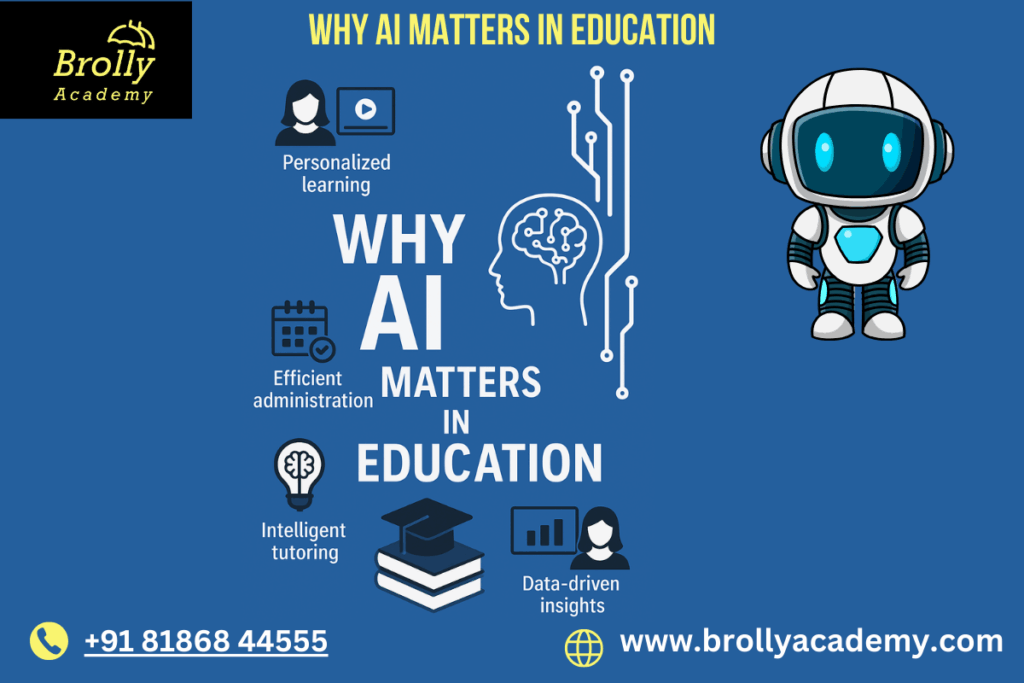
Why AI Matters in Education
- Artificial Intelligence plays a critical role in shaping the future of modern education systems.
- As academic environments evolve, traditional one-size-fits-all instructional methods are becoming less effective in meeting the diverse needs of students.
- Learners today require personalized support, flexible learning formats, and technology-driven tools that make education more accessible, efficient, and relevant to real-world requirements.
- This is where AI becomes a transformative component.
- AI matters in education because it enables highly scalable and efficient learning models that adapt to individual learner profiles, institutional requirements, and emerging workforce trends.
- Instead of relying solely on manual evaluation, standardized instruction, and routine administrative processes, AI introduces automation, data intelligence, and continuous optimization into the learning ecosystem.
Key Reasons AI Plays a Significant Role in Education
The following points explain the importance and impact of AI in educational environments:
1. Scalable Learning Experiences
AI-powered systems allow institutions to manage large student populations without compromising learning quality. Intelligent platforms can track learning outcomes, generate
customized learning recommendations, and evaluate performance automatically, making education more scalable than traditional models.
2. Personalized and Adaptive Instruction
Every student learns differently, and traditional education often struggles to accommodate individual learning styles, pace, or knowledge gaps. AI solves this challenge by enabling adaptive learning pathways. These systems adjust difficulty levels, learning resources, and instructional formats based on real-time learner progress and engagement patterns.
3. Real-Time Feedback and Assessment Accuracy
AI enables continuous monitoring and real-time assessment rather than waiting for periodic examinations. Students receive immediate feedback, allowing them to correct mistakes and reinforce learning instantly. Educators also benefit from detailed analytical insights on learner performance, behavior, and improvement areas.
4. Automation of Academic and Administrative Tasks
A significant portion of educators’ time is consumed by repetitive administrative responsibilities such as grading, attendance monitoring, report generation, and communication management. AI automates these processes, helping educators focus more on instructional quality, mentoring, and innovation rather than paperwork and coordination.
5. Data-Driven Decision-Making
Educational planning becomes more effective when supported by data insights. AI tools analyze large volumes of academic information to identify performance patterns, course effectiveness, and learning gaps. This analytical capability supports evidence-based decision-making in curriculum development, resource allocation, and institutional strategy.
6. Support for Skill-Based and Future Careers
As industries rapidly adopt automation, robotics, machine learning, and digital systems, students must be equipped with relevant skills to remain competitive. AI-driven learning environments help learners develop critical thinking, computational skills, digital literacy, and exposure to real-world problem-solving experiences.
7. Enhanced Learning Accessibility and Inclusivity
AI technologies support learners with disabilities or special learning requirements by providing assistive tools such as speech recognition, real-time translation, personalized content adjustments, and AI-driven sign language interpretation. This ensures equal learning opportunities for diverse student groups.
The Future Significance of AI in Academic Development
Education systems worldwide are transitioning from memory-based examination formats to competency-based and skill-oriented frameworks. As this shift accelerates, AI will act as a foundational engine powering:
● Intelligent tutoring systems
● Virtual classrooms and immersive learning platforms
● Predictive academic analytics
● Smart assessment and certification models
With these advancements, AI is not merely an optional technological upgrade. It is becoming a core requirement for delivering modern, globally competitive education.
Key Global Statistics Supporting AI Adoption in Education
- The rising adoption of Artificial Intelligence in global education systems demonstrates its transformative impact on academic outcomes, institutional operations, and learner-centered methodologies.
- The following statistics highlight the growing momentum behind AI-driven education and its long-term potential in reshaping learning landscapes.
Market Growth and Economic Impact
The global market size for AI in education is projected to exceed USD 30 billion by 2030, reflecting rapid growth driven by e-learning expansion, EdTech investments, and AI-powered education solutions.
● Countries including the United States, China, India, and Singapore are at the forefront of implementing AI-based digital learning ecosystems.
● Increased funding in EdTech startups and governmental initiatives indicates AI is becoming a fundamental pillar rather than an experimental element in educational reform.
Institutional Adoption Trends
● More than 48 percent of educational institutions worldwide have already implemented AI-powered Learning Management Systems (LMS), automated assessment tools, or intelligent tutoring systems.
● Universities are integrating AI-based student analytics platforms to track retention, engagement, assignment submissions, and performance trends in real time.
● Schools and colleges adopting AI systems report improved administrative efficiency and enhanced curriculum delivery.
4.3
Learning Efficiency and Student Outcomes
● Studies show that AI-driven personalized learning improves learner retention by over 60 percent, helping students progress at a pace aligned with their individual cognitive ability.
● More than 70 percent of students using AI tutoring and adaptive learning platforms demonstrate measurable academic improvement compared to those dependent only on traditional classroom methods.
● AI-based assessments reduce subjective grading errors and provide comprehensive feedback faster than manual evaluation.
Workforce Preparedness and Skills Development
● Over 65 percent of employers globally believe learners trained with AI-integrated education are better prepared for future careers.
● AI-based simulation platforms and virtual labs support hands-on training in STEM, cybersecurity, coding, robotics, and medical learning environments.
● Governments are encouraging AI readiness programs to equip students with industry-relevant skills such as critical thinking, automation handling, and data literacy.
Scalability and Accessibility Improvements
● AI language translation and speech recognition tools are enhancing accessibility for multilingual and differently-abled learners.
● Remote learning powered by AI continues to expand educational access to rural, underserved, and international students.
● AI-powered tools help institutions conduct classroom management, learning progress monitoring, and communication across thousands of students—something traditional systems cannot scale effectively.
Top Applications of AI in Education
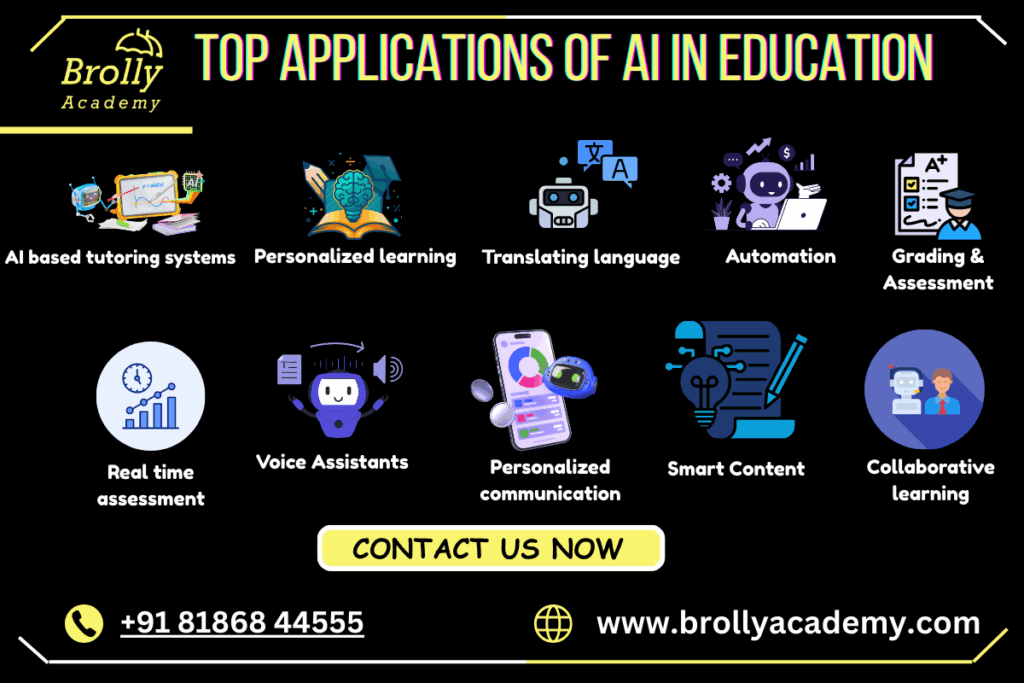
- The applications of Artificial Intelligence in education extend beyond automation and digital learning.
- They impact learning quality, accessibility, administrative efficiency, and the overall teaching methodology.
- These applications can be grouped under four major categories: learning enhancement, teaching support, institutional automation, and accessibility improvement. Below are the most impactful use cases explained in detail.
Personalized Learning
Personalized learning is one of the most transformative applications of AI. It addresses the limitation of one-size-fits-all education models by tailoring the learning experience to each learner’s pace, cognitive ability, and preferences.
Key components of personalized learning include:
● Adaptive content delivery based on performance and struggle points
● Real-time feedback during tasks, quizzes, and assignments
● Difficulty adjustments depending on learner progress
● Recommendation engines suggesting videos, assessments, quizzes, and study notes aligned with learning needs
Example: An AI-powered learning platform can detect whether a student is progressing quickly or struggling with a topic. It can then automatically adjust lesson complexity, offer hints, recommend extra practice material, or move ahead to advanced content.
Personalized learning helps bridge academic gaps and promotes deeper engagement and retention.
Intelligent Tutoring Systems
Intelligent Tutoring Systems (ITS) replicate the function of one-on-one tutoring through AI. These systems use natural language processing, machine learning, and cognitive modeling to interact with students in real time.
Core functions include:
● Instant resolution of questions and learning doubts
● Step-by-step learning support based on student responses
● Personalized hints, corrections, and topic reinforcement
● Monitoring emotional engagement to modify teaching tone and pace
ITS allows learning to continue beyond school hours and supports both self-paced and structured learning formats.
Smart Content Creation
AI assists in generating digital learning materials customized for academic level and institutional goals. This reduces the manual effort required for curriculum design and content development.
Smart content includes:
● AI-generated textbooks and learning modules
● Auto-created flashcards, quizzes, and summaries
● Curriculum-based personalized study plans and schedules
● Interactive simulations and virtual demonstration models
Smart content creation ensures alignment with learning outcomes and increases content accessibility across multiple languages and formats.
Task Automation
Administrative automation is a major area where AI is reducing educator workload and improving system efficiency.
Tasks frequently automated include:
● Attendance tracking
● Assignment correction and scoring
● Scheduling and reminders
● Communication mapping between teachers, students, and parents
● Grade monitoring and report generation
Automation enables educators to focus more on instruction, mentorship, and innovation rather than repetitive administrative tasks.
Data-Driven Decision-Making
AI processes and evaluates large volumes of academic data to assist institutional planning and student support systems.
Applications include:
● Identifying skill gaps and weak learning areas
● Predicting exam outcomes based on study patterns
● Assessing classroom attention and engagement
● Suggesting corrective actions for improvement
Institutions use these insights to design better teaching strategies, develop intervention plans, and improve curriculum structure.
AI-Powered Accessibility Support
AI ensures that education remains inclusive and accessible, especially for differently-abled learners.
Examples include:
● Speech-to-text conversion for hearing-impaired learners
● Text-to-speech tools for visually impaired students
● Sign language translation using AI gesture recognition
● Emotion recognition systems for neurodivergent learners to assess comfort and stress levels
These tools make education equitable and support compliance with global inclusion standards.
Virtual Learning Environments and Digital Classrooms
AI enhances virtual learning platforms to provide digital classroom experiences that mirror real-world engagement.
Features include:
● Collaborative learning environments
● Automated content sharing and classroom organization
● AI-supported virtual labs and simulation experiences
These tools became essential during global transitions to remote and hybrid learning models and continue to shape modern educational structures.
AI-Driven Evaluation and Examination Systems
AI supports efficient, accurate, and bias-free evaluations through:
● Automated exam proctoring that detects suspicious behavior
● Instant scoring for objective and structured responses
● AI-supported evaluation assistance for written tasks
● Real-time feedback and grading transparency
These systems minimize grading errors and increase fairness in assessment.
Predictive Analytics for Student Retention
AI-powered predictive models identify:
● Dropout or disengagement risk
● Declining academic performance patterns
● Behavioral triggers affecting learning quality
Institutions can use this information for early intervention, academic restructuring, or individualized student support services.
AI for Skill-Based and Experiential Learning
Practical and industry-oriented learning is supported through:
● AI coding assistants for programming practice
● Medical and engineering simulations
● Virtual laboratories for science experiments
● AI-powered learning for robotics, automation, and industrial training
These tools prepare students for real-world environments without requiring physical infrastructure in every case.
Application Area | Description | Examples / Tools |
Personalized Learning | AI customizes learning paths based on student performance, pace, and interests for better outcomes. | DreamBox, Knewton, BYJU’S |
Intelligent Tutoring Systems | Provides 24/7 AI-based tutoring, instant answers, and concept reinforcement. | Google Socratic, Khan Academy AI Tutor |
Automated Grading & Assessment | AI evaluates assignments, quizzes, and tests, reducing teacher workload. | Gradescope, Turnitin |
AI-Powered Content Creation | Generates smart content like quizzes, summaries, flashcards, and learning modules. | Quillionz, ChatGPT |
Adaptive Learning Platforms | Continuously adjusts difficulty levels and resources based on student progress. | Coursera, Udacity AI Systems |
Virtual Classrooms & AI Assistants | AI chatbots and assistants support students with reminders, doubt-solving & study tips. | Duolingo Bots, Microsoft Education AI |
Student Performance Analytics | Tracks learning behavior, predicts outcomes, and helps teachers refine strategies. | PowerSchool, Edmentum |
Administrative Automation | Automates attendance, scheduling, communication, and record management. | Teachmint, School ERP Systems |
Career Guidance & Skill Mapping | AI recommends career paths, skills, and courses based on student interests and performance. | LinkedIn Learning AI, Coursera Career AI |
Special Education Support | Provides voice assistance, text-to-speech, learning aids, and personalized support for differently-abled students. | Otter.ai, Seeing AI |
Gamified Learning & Simulations | Uses AI to create engaging, interactive simulations and gamified lessons. | Labster, Minecraft Education |
Language Learning & Translation | AI improves pronunciation, grammar, and fluency with real-time feedback. | Duolingo, Grammarly |
Security & Student Safety Monitoring | AI ensures safer campuses through surveillance, ID verification, and behavior tracking. | SecureCampus AI, Face Recognition Systems |
.
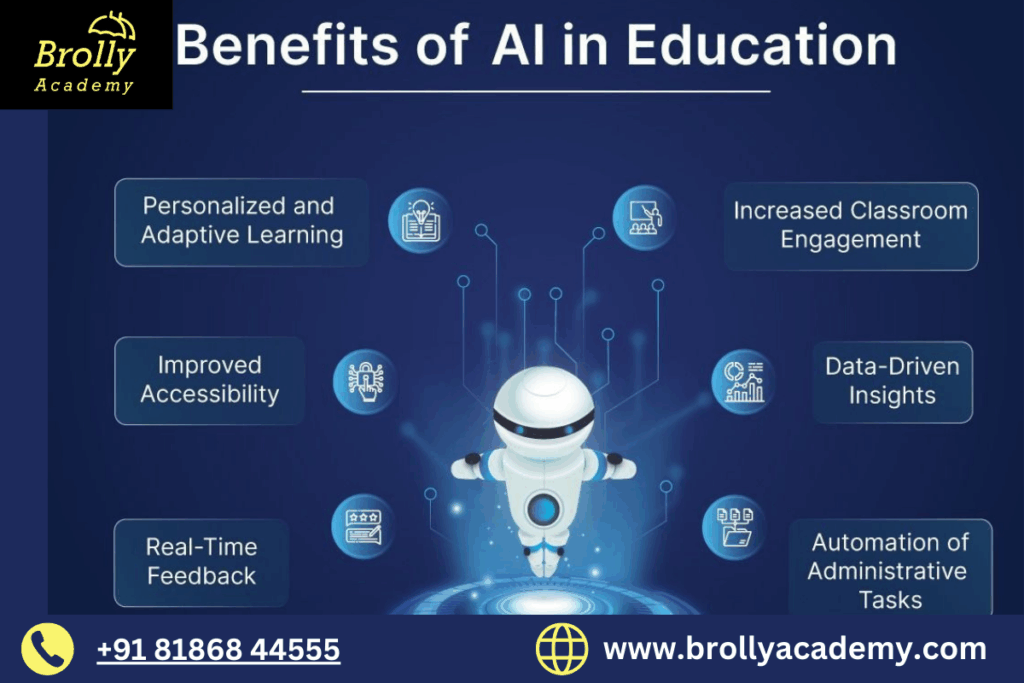
Benefits of AI in Education
- Artificial Intelligence is transforming education by improving learning outcomes, enhancing operational efficiency, and creating more inclusive and flexible academic environments.
- These benefits impact students, educators, institutions, and lifelong learners across various educational levels. The following section explains the major advantages of AI in education with detailed descriptions.
Improved Personalization and Engagement
AI enables highly personalized learning experiences by analyzing individual learner behavior, pace, strengths, and challenges. Unlike traditional teaching methods, where one approach is applied to an entire classroom, AI customizes teaching strategies for each learner.
Key benefits include:
● Learning pathways adapted to student ability levels
● Personalized assignments, quizzes, and reading plans
● Dynamic lesson updates based on student progress
● Interactive AI-driven learning environments that increase motivation
This enhances engagement, increases knowledge retention, and reduces academic frustration caused by mismatched learning speeds.
Faster Evaluation and Feedback Cycles
AI enables automated evaluation systems capable of assessing assignments, quizzes, and written responses with minimal manual effort.
Advantages include:
● Instant scoring for objective and structured questions
● AI-supported grading for essays and analytical responses
● Immediate feedback, allowing learners to correct errors quickly
● Reduced grading errors and subjective bias
Faster evaluations help students track their progress and give educators more time to focus on teaching quality rather than manual assessments.
Reduced Administrative Workload
Educators spend a significant portion of time on tasks such as attendance tracking, grading, record updates, and classroom coordination. AI automates these time-consuming tasks.
Automation benefits include:
● Attendance and class management automation
● Scheduling, report cards, and communication assistance
● Resource and timetable allocation with minimal human input
As administrative tasks become automated, educators can focus more on research, curriculum improvement, and mentoring students.
Advanced Accessibility Support
AI supports inclusive and equitable education, ensuring differently-abled learners receive the resources they need to learn effectively.
Examples of accessibility enhancements include:
● Speech-to-text systems for those with hearing challenges
● Text-to-speech tools for visually impaired learners
● AI-driven content translation for multilingual students
● Assistive tools supporting autism, dyslexia, and cognitive diversity
These features enhance access to learning and help institutions align with global accessibility standards.
Improved Institutional Efficiency
AI-driven systems enhance planning, monitoring, and decision-making processes within schools, colleges, and universities.
Institution-wide improvements include:
● Predictive analytics for policy and curriculum refinement
● Streamlined administrative processes and record management
● Efficient resource use, infrastructure planning, and course scheduling
● Reduction in operational errors and increased digital efficiency
Institutions using AI experience better productivity and reduced operational complexity.
Continuous and Flexible Learning Opportunities
AI supports learning beyond the traditional classroom environment and time constraints. This benefit is especially valuable for remote learners, working professionals, and self-paced learners.
Advantages include:
● Learning available anytime and anywhere
● AI tutors offering round-the-clock support
● HyFlex and virtual classroom models accommodating varied schedules
● Access to customized content and assessment modules
This flexibility supports lifelong learning and accommodates diverse learner needs.
Better Data Insights for Education Planning
Educational institutions generate large volumes of student performance and behavior data. AI analyzes this data to support planning, intervention, and strategy building.
Key insights include:
● Areas where students commonly struggle
● Patterns predicting performance outcomes
● Early-warning indicators for dropouts or academic failure
● Effectiveness of teaching strategies and course structures
These insights allow institutions to make informed, evidence-based decisions that strengthen learning outcomes.
Scalability for Large Student Populations
AI-driven platforms can support hundreds or thousands of learners simultaneously without compromising quality. This makes AI crucial for large-scale educational reforms and nationwide digital learning initiatives.
Scalability benefits include:
● Standardized delivery of high-quality instruction
● Efficient automated academic support systems
● Affordable learning solutions accessible to large populations
● Growth-ready digital infrastructure for expanding institutions
Scalability ensures that education systems can grow without additional teaching or administrative burden.
Future Trends of AI in Education
- As AI continues to evolve, its role in education is expanding beyond automation and personalized learning.
- The future promises intelligent, adaptive, and interconnected educational ecosystems where learning becomes continuous, immersive, and deeply individualized. The following trends highlight how AI will shape the future of global academic and lifelong learning systems.
Autonomous Learning Systems
Autonomous learning systems represent a future where AI acts as a complete learning facilitator rather than a support tool. These systems will guide students through academic content independently while adapting to their progress.
Key characteristics include:
● Self-directed pacing without human intervention
● Continuous updates based on learning accuracy
● AI-generated lessons and practice modules
● Automated assessment and performance improvement suggestions
These systems will help learners develop independence, making education more flexible and accessible across geographical and cultural boundaries.
Emotion-Adaptive Teaching Models
Future AI systems will not only track academic performance but also recognize emotional cues such as confusion, confidence, stress, or disengagement.
Features include:
● Facial expression analysis
● Voice recognition for tone and stress patterns
● Behavioral tracking through interaction patterns
● Real-time content adjustment based on emotional feedback
Emotion-adaptive AI can provide timely support and personalized interventions, ensuring students remain motivated and mentally supported throughout the learning process.
AI-Powered Lifelong Micro-Credential Learning
As job markets evolve rapidly, lifelong learning will become essential. Micro-credentialing supported by AI will allow individuals to learn in modular, skill-based formats aligned with evolving industry demands.
Future developments include:
● Personalized skill-based learning paths
● Competency-based evaluations instead of traditional test scores
● Dynamic certification systems linked to real-time skill analytics
● Integration with employment platforms for career alignment
This shift will help learners continuously upskill and remain relevant in technology-driven career environments.
Blockchain-Based Academic Verification
Blockchain technology will work with AI to ensure secure, tamper-proof academic record verification. This will transform how institutions, employers, and global agencies validate student credentials.
Expected outcomes include:
● Secure digital diplomas and transcripts
● Instant verification of skills, achievements, and academic history
● Fraud-proof identity management and certificate authentication
● Seamless portability of academic credentials across borders
Blockchain integration will support academic transparency and eliminate lengthy verification processes.
Fully Immersive AI-Driven Metaverse Classrooms
The future of learning will include immersive digital classrooms where AI combines virtual reality, augmented reality, and intelligent simulation engines.
Features include:
● Interactive 3D environments for hands-on learning
● AI tutors and holographic instructors
● Virtual laboratories for science, engineering, and medical practice
● Collaborative global learning with students from different locations
These metaverse-based environments will transform passive learning into experiential and interactive education.
Conclusion
- Artificial Intelligence is reshaping educational structures and transforming traditional learning environments into intelligent, scalable, and learner-centered ecosystems.
- The applications explored—from personalized learning and intelligent tutoring to predictive analytics and immersive virtual classrooms—demonstrate how AI enhances academic quality, efficiency, and accessibility.
As schools, universities, and training institutions increasingly adopt AI-powered platforms, the education system continues to shift toward:
● Personalization rather than standardization
● Automation rather than manual processes
● Data-driven decision-making rather than assumption-based planning
● Global accessibility rather than limited classroom reach
This shift signifies a future where learning is continuous, independent, and deeply adaptive.
- Ultimately, adopting AI in education is no longer a futuristic possibility—it is a necessary transformation.
- Institutions embracing AI will better prepare learners for technology-driven industries, emerging digital roles, and a world where AI and human intelligence coexist and collaborate.
- The integration of Artificial Intelligence marks a significant step forward in the evolution of education, paving the way for smarter, equitable, and innovative learning experiences for all
FAQs
1. What are the main applications of AI in education?
AI is used for personalized learning, automated grading, smart content creation, adaptive assessments, virtual tutors, analytics, and classroom automation.
2. How does AI improve personalized learning?
AI analyzes student performance and customizes lessons based on learning pace, strengths, and weaknesses.
3. What is an intelligent tutoring system (ITS)?
It’s an AI-driven virtual tutor that offers real-time guidance, explanations, and feedback to students.
4. How does AI help teachers?
AI reduces repetitive tasks like grading, attendance, and scheduling, so teachers can focus more on teaching.
5. What role does AI play in student assessments?
AI creates adaptive tests that adjust question difficulty based on student responses for accurate evaluation.
6. Can AI improve student engagement?
Yes, AI uses interactive tools, gamified learning, and customized content to keep students interested.
7. How is AI used in virtual classrooms?
It powers chatbots, attendance tracking, interactive quizzes, and virtual learning assistants in online classes.
8. What is AI-powered adaptive learning?
A learning system that adjusts content difficulty and topics based on student behavior and performance.
9. How does AI support students with disabilities?
AI tools like speech-to-text, text-to-speech, and visual recognition make learning accessible.
10. What is automated grading in AI?
AI evaluates tests, assignments, and quizzes instantly, saving teachers time and improving consistency.
11. How does AI enhance online learning platforms?
Through personalized dashboards, automated recommendations, reminders, and progress tracking.
12. What is the role of AI chatbots in education?
Chatbots answer student queries, provide learning support, and help with admissions and course inquiries.
13. Can AI help reduce dropout rates?
Yes, predictive analytics identify at-risk students early so educators can intervene on time.
14. How does AI help in content creation?
AI generates quizzes, summaries, explanations, and visual content based on curriculum needs.
15. What are AI-based learning analytics?
Insights that analyze student behavior, performance, and progress to improve teaching strategies.
16. How does AI support emotional well-being?
AI can detect stress levels using voice or pattern analysis and suggest supportive resources.
17. What is the use of AI in administrative tasks?
It automates admissions, scheduling, grading, attendance, and student management systems.
18. How does AI assist slow learners?
AI gives extra practice, step-by-step guidance, and tailored lessons to improve understanding.
19. Can AI help fast learners?
Yes, AI accelerates learning paths and provides advanced modules for quick progress.
20. How does AI enable real-time feedback?
AI evaluates responses instantly and gives clear corrections and personalized suggestions.
21. What AI tools are widely used in education?
ChatGPT, Google AI, Microsoft Copilot, Coursera AI, Duolingo AI, and smart classroom tools.
22. How is AI used in language learning?
Through speech recognition, pronunciation correction, chat-based practice, and vocabulary tools.
23. What is the future of AI in education?
Fully automated classrooms, AR/VR-powered lessons, hyper-personalized learning, and AI mentors.
24. Does AI replace teachers?
No, AI supports teachers by automating tasks, but human educators remain essential for mentorship and guidance.
25. How does AI support collaborative learning?
AI tools enable group projects, peer-learning suggestions, and interactive discussion platforms.
26. Is AI helpful for exam preparation?
Yes, AI apps provide practice questions, mock tests, personalized study plans, and instant solutions.
27. How does AI ensure data security in education?
Advanced AI security systems protect student data through encryption and anomaly detection.
28. What are AI-driven smart classrooms?
Classrooms equipped with AI cameras, sensors, and tools that enhance tracking, teaching, and safety.
29. How does AI support research and projects?
It helps with data analysis, idea generation, literature summaries, and project automation.
30. What challenges exist in using AI in education?
Challenges include cost, lack of training, data privacy concerns, and reliance on technology.