
Overview Of The Role Of AI In Digital Marketing
Table of Contents
Toggle- Artificial Intelligence (AI) is transforming digital marketing by helping businesses analyze data faster, understand customer behavior, and deliver highly personalized experiences.
- With AI-powered tools like predictive analytics, automation, chatbots, and intelligent targeting, marketers can optimize campaigns, reduce costs, and improve ROI like never before.
- From SEO and content creation to social media, email marketing, and paid ads, AI enhances every marketing channel with real-time insights and data-driven decision-making.
- As digital competition grows, the role of AI in digital marketing becomes essential—enabling brands to automate repetitive tasks, personalize customer journeys, and drive smarter, faster, and more effective marketing strategies that deliver stronger results.
Role of AI in Digital Marketing
Introduction
- The digital marketing landscape has evolved significantly in the last decade.
- With increased online activity, rising competition, and the growing availability of customer data, businesses are
now pushed to adopt highly efficient methods for planning, executing, and optimizing campaigns. - Artificial Intelligence (AI) has emerged as one of the most transformative technologies, reshaping how brands interact with audiences, refine marketing strategies, and make data-driven decisions.
- The role of AI in digital marketing extends beyond automation or analytics.
- It enables intelligent decision-making, enhances personalization, optimizes budgeting, improves customer engagement, and ensures measurable results.
- Today, whether it is search engine optimization, paid advertising, customer service, content generation, or predictive analytics, AI plays an essential role across every domain of digital marketing.
- As customer expectations increase and online ecosystems expand, adopting AI is no longer optional—it is necessary for competitiveness and long-term sustainability.
- This article provides a detailed examination of the role of AI in digital marketing, including its benefits, applications, use cases, real-time optimization capabilities, technical adoption strategies, industry examples, and future potential.
Understanding the Role of AI in Digital Marketing
- Artificial Intelligence refers to systems and technologies that simulate human intelligence processes such as reasoning, decision-making, learning, pattern recognition, and natural language understanding.
- In digital marketing, AI assists marketers by automating repetitive tasks, analyzing large datasets, recognizing patterns, and delivering predictions faster than manual processes could achieve.
Key Functions of AI in Marketing:
- Automates complex workflows
- Supports predictive forecasting
- Enhances customer engagement and retention
- Personalizes marketing content and offers
- Improves campaign ROI through real-time optimization
AI-driven systems process millions of user actions—from search queries to browsing activities—to help marketers deliver relevant and behavior-driven messaging.
Data Analysis and Insights
- Data is the backbone of modern digital marketing, and Artificial Intelligence significantly enhances how this data is collected, processed, interpreted, and utilized.
- One of the most impactful roles of AI in digital marketing is its advanced capability to perform deep data analysis, something that manual methods or traditional analytics tools cannot match at scale.
- AI-driven systems can analyze both structured and unstructured data from multiple channels in real time, transforming raw information into strategic and actionable insights.
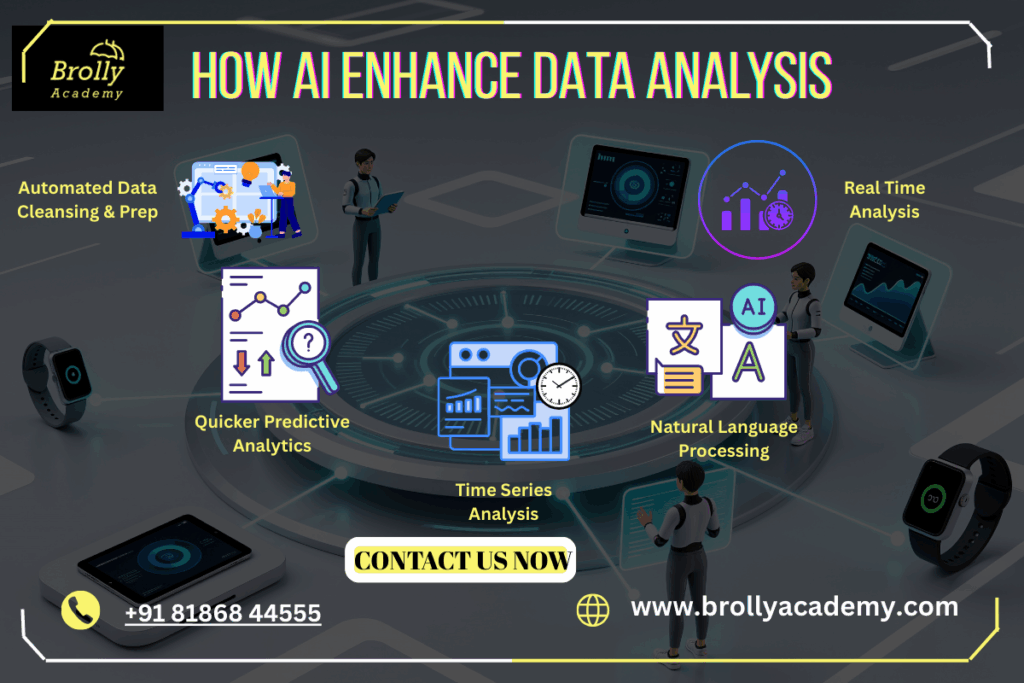
How AI Enhances Data Analysis
1. Automated Data Collection and Segmentation
AI systems streamline the process of collecting customer and marketing data across multiple digital touchpoints, including:
- Websites and mobile app
- Email marketing platforms
- Social media channels
- CRM databases
- Third-party marketing and automation tools
Once gathered, AI algorithms automatically categorize and segment this data based on:
- Demographic clusters
- Behavioral engagement level
- Purchase intent
- Browsing and interaction patterns
- Customer lifecycle stage
This automated approach eliminates human error, accelerates analysis time, and enables marketers to build more accurate and dynamic audience profiles.
2. Pattern Recognition and Predictive Analytics
AI has the capability to detect recurring behavioral patterns and hidden insights that may not be visible through traditional analysis methods. Using advanced machine learning models, AI identifies:
- Purchase motivation triggers
- Seasonal buying behavior
- Customer value peaks and disengagement signals
- Preferred devices, content formats, and interaction channels
Predictive analytics allows marketers to anticipate:
- Future purchase decisions
- Customer drop-off points
- Upsell and cross-sell opportunities
- Market demand trends
- Campaign outcomes before execution
This predictive ability enhances the strategic role of AI in digital marketing by reducing risk and improving planning accuracy.
3. Behavioral and Sentiment Insights
AI-powered Natural Language Processing (NLP) enables marketers to analyze text-based customer feedback from multiple sources, such as:
● Reviews and ratings
● Social media comments
● Support interactions
● Online forums and survey responses
Sentiment analysis identifies:
● Positive perception drivers
● Customer frustrations and pain points
● Trends in emotion-based engagement
● Brand loyalty or dissatisfaction triggers
These insights help businesses refine messaging, product positioning, and communication tone to build stronger customer relationships.
4. Real-Time Dashboards
Real-time analytics is one of the most valuable contributions of AI in digital marketing. AI dashboards eliminate the need for manual reports and provide instant visibility into:
● Campaign metrics
● Conversion performance
● Audience engagement levels
● Budget utilization trends
● Funnel effectiveness
This allows marketing teams to respond quickly to performance fluctuations and optimize campaigns while they are running—not after they end.
Tools Supporting AI-Based Insights
Several industry-leading platforms integrate AI to support advanced analytical capabilities, including:
● Google Analytics 4
● IBM Watson Marketing
● Tableau
● Microsoft Power BI
● Salesforce Einstein
These tools help marketers track performance, detect patterns, measure ROI, and build predictive models that enhance strategic decision-making.
Impact on Decision-Making
With enhanced accuracy, real-time reporting, and predictive forecasting, AI directly supports smarter and data-driven decision-making. Businesses leveraging AI analytics benefit from improved clarity in areas such as:
● Targeting accuracy AI ensures audience segments are refined and precise, increasing conversion potential.
● Campaign planning Predictive data helps determine the best messaging, platforms, formats, and timelines.
● Content performance evaluation AI identifies which content resonates most with specific audience segments.
● Customer lifetime value forecasting AI measures loyalty potential, purchasing frequency, and long-term value.
● Market trend prediction AI enables brands to stay ahead of shifts in demand, behavior, and competition.

Automation and Efficiency
- One of the most transformative roles of AI in digital marketing is automation.
- AI automation enables marketing operations to run with higher accuracy, consistency, and speed by handling repetitive tasks that previously required human effort.
- This shift reduces manual workload, minimizes errors, accelerates execution, and significantly enhances operational efficiency.
- As businesses scale, AI automation becomes an indispensable component for maintaining performance and competitiveness.
Areas Where AI Enhances Automation
1. Email Campaign Management
AI-powered email platforms automate the entire email marketing lifecycle. This includes:
● Automated drip workflows
● Trigger-based messages based on actions such as cart abandonment or product views
● Smart delivery timing based on user engagement patterns
● AI-assisted personalization for subject lines, recommendations, and messaging tone
These capabilities result in better open rates, improved click-through rates, higher conversions, and enhanced customer retention.
2. Lead Scoring and Qualification
AI uses behavioral data, historical interactions, and predictive analytics to evaluate and categorize leads based on:
● Purchase intent
● Engagement score
● Conversion likelihood
● Recency and frequency of interaction
This helps sales and marketing teams prioritize high-potential leads, improving efficiency and accelerating sales cycles.
3. Social Media Management
AI streamlines social media marketing by automating tasks such as:
● Post scheduling across platforms
● Content recommendation based on audience insights
● Hashtag and caption suggestions
● Trend detection and competitor benchmarking
AI also assists in identifying viral opportunities, optimizing post timing, and ensuring a consistent brand presence across platforms.
4. Chatbots and Conversational AI
AI-powered chatbots and virtual assistants provide:
● 24/7 customer support
● Multilingual responses
● Automated FAQs and troubleshooting
● Personalized product recommendations
● Feedback collection and user routing
These systems reduce the workload on support teams while delivering instant responses that improve customer satisfaction and engagement.
5. Reporting and Campaign Adjustments
AI analytics platforms automatically generate performance insights and optimize campaigns by adjusting:
● Bidding strategies
● Audience targeting
● Budget allocation
● Creatives and messaging based on engagement data
This real-time optimization helps marketers achieve better ROI and maintain campaign efficiency without constant manual intervention.
Benefits of AI Automation
The integration of AI-driven automation offers several strategic advantages:
1. Reduced operational cost Less manual workload and optimized resource utilization result in cost efficiency.
2. Faster execution of marketing workflows Automated systems perform tasks instantly, shortening campaign launch time.
3. Increased accuracy and consistency AI removes human error, ensuring data-driven precision in execution.
4. Improved productivity and resource alignment Teams can shift focus from repetitive tasks to strategic planning and innovation.
5. Enhanced customer experience Automated personalization and real-time interaction strengthen customer relationships and satisfaction.
Role Of AI in Digital Marketing
AI Function | Description | Benefits |
Customer Targeting | Uses data analysis and machine learning to find the right audience. | Higher accuracy, improved ad ROI. |
Personalization | Delivers customized content, product suggestions, and recommendations. | Better engagement and conversions. |
Content Creation | Generates blogs, captions, emails, and creatives using AI tools. | Saves time, maintains consistency. |
SEO Optimization | Analyzes keywords, search intent, and website performance. | Higher rankings, better traffic. |
Marketing Automation | Automates repetitive tasks like emails, ads, and lead nurturing. | Boosts efficiency and reduces workload. |
Predictive Analytics | Forecasts trends, customer behaviour, and future outcomes. | Better decision-making and strategy planning. |
Paid Advertising Optimization | Automates bidding, targeting, and ad placement. | Reduced ad spend and better results. |
Chatbots & Virtual Assistants | Provides automated customer support and lead qualification. | 24/7 support and faster responses. |
Social Media Insights | Analyzes user behavior and trending content. | Increases reach and engagement. |
Customer Journey Mapping | Tracks user interactions across platforms to improve UX. | Higher conversions and improved retention. |
Personalized Customer Experiences
- Personalization has evolved from a marketing trend to a strategic necessity.
- Today’s consumers expect brands to understand their needs, anticipate their interests, and provide relevant messaging across platforms.
- AI plays a significant role in digital marketing by enabling hyper-personalization—going beyond basic segmentation to deliver unique user experiences in real time.
- AI processes behavioral signals, browsing patterns, purchase history, device usage, demographic inputs, and psychographic insights to tailor the customer journey.
This ensures that every interaction feels timely, relevant, and personal.
Applications of AI in Personalization
1. Dynamic Landing Pages
AI-driven website personalization adjusts web content dynamically based on user intent and behavior. This includes:
● Personalized headers and messaging
● Tailored calls-to-action (CTAs)
● Product or service recommendations
● Geo-based content modifications
For example, an e-commerce visitor viewing sports shoes may later see similar or complementary items like accessories or style suggestions.
2. AI-Based Content Recommendations
AI recommendation engines analyze user preferences and interaction patterns to recommend relevant content or products. This application is widely used by:
● YouTube for video recommendations
● Netflix for genre-based viewing suggestions
● Spotify for personalized playlists
● Amazon for product recommendations and bundled offers
Recommendation engines significantly enhance user retention by increasing content relevance and engagement frequency.
3. Behavioral Email Personalization
AI enhances email marketing by tailoring communication to individual user behavior. This includes:
● Personalized subject lines based on interest and tone detection
● Recommended products based on browsing or purchase history
● Predictive analysis for optimal send time
● Content variations based on audience segment and engagement metrics
AI ensures that each recipient receives personalized content, improving open and click-through rates.
4. Adaptive Advertising
AI improves advertising efficiency by creating adaptable ad experiences based on:
● Search history
● Browsing frequency
● Abandoned carts
● Engagement signals
● Previous interaction with brand channels
Examples include automated retargeting ads shown on social platforms, Google Display Network, or website banners—designed to remind or persuade the user to take the desired action.
Why Personalization Matters
AI-powered personalization provides measurable marketing advantages:
1. Increases User Engagement Relevant content keeps users active and encourages return visits.
2. Enhances Conversion Rates Personalized recommendations and adaptive ads lead to higher purchase intent and faster decision-making.
3. Builds Brand Loyalty and Customer Trust Personalized experiences demonstrate understanding and relevance, strengthening long-term relationships.
4. Reduces Marketing and Acquisition Costs Personalized targeting minimizes wasted ad spend and improves ROI.
5. Improves Customer Lifetime Value (CLV) When users receive meaningful interactions, the likelihood of repeat purchases increases, extending overall customer value.
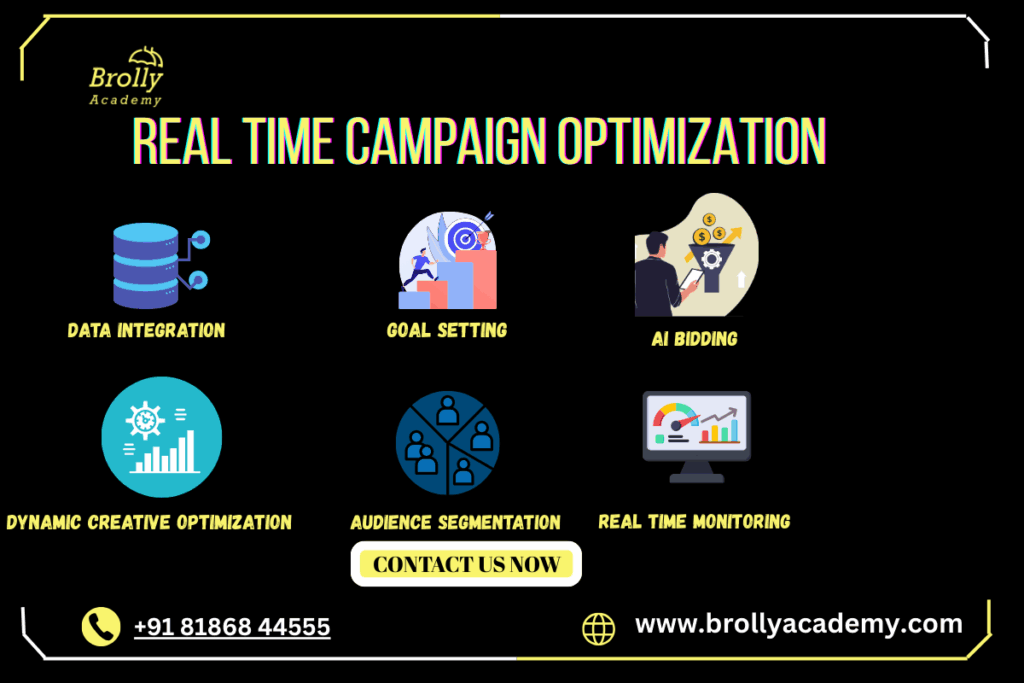
Real-Time Campaign Optimization
- Real-time optimization is one of the most advanced and impactful capabilities of artificial intelligence in digital marketing.
- Unlike traditional marketing strategies that rely on manual adjustments and periodic reporting, AI enables continuous monitoring and automatic refinement of campaigns based on live performance data.
- This ensures higher accuracy, faster response times, improved cost efficiency, and better return on investment (ROI).
- AI-powered optimization models analyze large datasets from multiple platforms—including search engines, social media, email marketing platforms, and paid advertising dashboards—to detect performance variations and execute corrective actions instantly.
Capabilities of AI Optimization Systems
1. Budget Allocation Adjustments
AI systems monitor campaign performance across channels and automatically distribute budget to high-performing formats, audiences, or platforms. This ensures that advertising spend is optimized in real time.
Examples include:
● Shifting ad spend from low-performing channels
● Increasing investment in campaigns with high conversion signals
● Reducing wasted budget caused by low-engagement segments
This dynamic allocation prevents overspending and enhances overall campaign efficiency.
2. Smart Bidding Strategies
AI-driven bidding systems in platforms like Google Ads and Meta Ads implement smart bidding to maximize outcomes based on:
● Conversions
● Cost per acquisition (CPA) targets
● Return on ad spend (ROAS) goals
● User intent signals and real-time market competition
AI adjusts bids automatically—ensuring businesses achieve their KPIs without continuous manual intervention.
3. Audience Targeting Optimization
AI improves targeting accuracy through behavioral, demographic, and psychographic analysis. It adapts audiences in real time by:
● Removing low-quality or disengaged users
● Identifying emerging audience clusters
● Enhancing targeting precision using lookalike and predictive audiences
This improves engagement and ensures ads reach users most likely to convert.
4. Content and Timing Optimization
AI models determine:
● Which type of content performs best (text, video, carousel, long-form, short-form), including visuals enhanced through Image to Video AI for higher engagement.
● When users are most active across different platforms, helping brands schedule campaigns more effectively.
● Which messaging style generates maximum engagement, especially when paired with immersive audio using AI Voice Cloning.
This approach ensures that ads, emails, and social content are delivered at optimal times for maximum visibility and interaction, often refined further with insights from a powerful video editor.
5. Channel Prioritization
AI compares performance across multiple marketing channels and determines which platforms yield higher ROI. Examples include:
● Shifting priority from display ads to social campaigns
● Scaling high-performing email automation workflows
● Enhancing organic or paid video strategies based on engagement analytics
This helps businesses invest in the most impactful channels rather than distributing efforts evenly across platforms.
Benefits of Real-Time Optimization
Implementing AI-driven optimization provides significant measurable advantages, including:
● Continuous performance improvement
● Reduced cost per click (CPC) and cost per acquisition (CPA)
● Increased conversion rates and ROI
● Faster response to user behavior and market changes
● Improved campaign scalability and performance consistency
AI Applications Across Digital Marketing Channels
Artificial Intelligence is now deeply integrated into major digital marketing channels, enabling smarter execution, predictive decision-making, and improved campaign performance. By leveraging AI across SEO, content creation, paid advertising, customer engagement, and social media, businesses can streamline workflows, personalize interactions, and scale operations efficiently.
Below is a detailed breakdown of how AI supports different digital marketing domains.
1. AI in SEO (Search Engine Optimization)
AI plays a critical role in improving SEO strategies by analyzing search intent, competitor patterns, keyword performance, and ranking signals. It enables advanced optimization techniques that go beyond traditional keyword research.
Applications of AI in SEO
● Predictive Ranking Analysis AI tools analyze SERP trends, competitor strength, and content relevance to forecast ranking potential. This assists marketers in prioritizing keywords with high success probability.
● Automated Content Audits AI-driven SEO platforms automatically assess technical SEO elements including broken links, page speed, metadata gaps, crawlability, and schema structure.
● Keyword Clustering and Intent Classification Machine learning groups keywords into clusters based on semantic similarity and identifies the user intent behind search queries.
● Voice Search Optimization With increasing usage of digital assistants, AI enhances voice query optimization by supporting natural language search patterns and conversational keyword modeling.
Tools Supporting AI in SEO
● SurferSEO
● SEMrush AI
● Clearscope
● RankIQ
● Google RankBrain–driven search insights
2. AI in Content Creation
AI significantly supports content strategy by improving planning, research, drafting, and performance evaluation. It leverages Natural Language Processing (NLP) and natural language generation techniques to enhance quality and consistency.
Applications of AI in Content Creation
● NLP-Based Writing Tools AI systems help generate blog posts, ad copy, landing page content, captions, and product descriptions based on tone, topic, and context guidelines.
● Automated Content Structuring and Editing AI tools assist with grammar, formatting, clarity, and style improvement while aligning with SEO and reader engagement patterns.
● Plagiarism Detection and Originality Scoring AI checks originality and identifies duplicated content before publishing, ensuring compliance with SEO best practices.
Examples of AI Content Tools
● Grammarly
● Jasper AI
● Copy.ai
● Quillbot
● Writesonic
3. AI in Paid Advertising
AI transforms paid advertising by executing decisions at scale with data-driven accuracy. It evaluates real-time competitive conditions, bid fluctuations, and user engagement patterns to optimize conversions.
Applications in Paid Ads
● Smart Campaign Structures Platforms such as Google Ads and Meta Ads use AI to automate bidding, targeting, and ad delivery based on conversion goals.
● Creative Variation Testing (A/B AI Optimization) AI evaluates multiple creative formats—headlines, visuals, descriptions, and CTAs—to identify the highest-performing combinations.
● Automated Ad Placement and Spend Optimization AI distributes budgets across best-performing channels, demographics, and devices.
Platforms Leveraging AI in Paid Ads
● Google Performance Max
● Meta Advantage+
● Amazon Sponsored Ads Automation
4. AI in Customer Service
AI improves customer support quality, response time, and scalability through conversational interfaces and intelligent routing systems.
Applications in Customer Service
● Conversational AI and Virtual Assistants AI chatbots deliver automated responses, guide users through decision paths, and
resolve common questions without human assistance.
● Voice Assistant Integration AI enables hands-free interactions through speech recognition technologies used in platforms such as Siri, Alexa, and Google Assistant.
● Behavioral Response Prediction AI analyzes previous interactions to predict user needs and deliver more relevant support.
Examples of AI Customer Support Tools
● Drift
● Intercom AI
● Ada
● Freshworks AI Suite
5. AI in Social Media Marketing
AI enhances social media strategy by identifying patterns in consumer behavior, content performance, and audience segmentation.
Applications of AI in Social Media Marketing
● Trend and Sentiment Analysis AI monitors hashtags, user reactions, and brand mentions to determine public sentiment and trending topics.
● Audience Segmentation and Target Optimization AI classifies users based on interest clusters, engagement history, geography, and demographics.
● Automated Scheduling and Content Timing AI tools schedule posts at optimal engagement times, improving reach and interaction rates.
● Predictive Content Suggestions AI systems recommend content formats, captions, and hashtags based on previous
insights.
AI Tools Used in Social Media Marketing
● Hootsuite AI
● Buffer AI
● Sprout Social
● Ocoya
● Meta Business Suite Intelligence
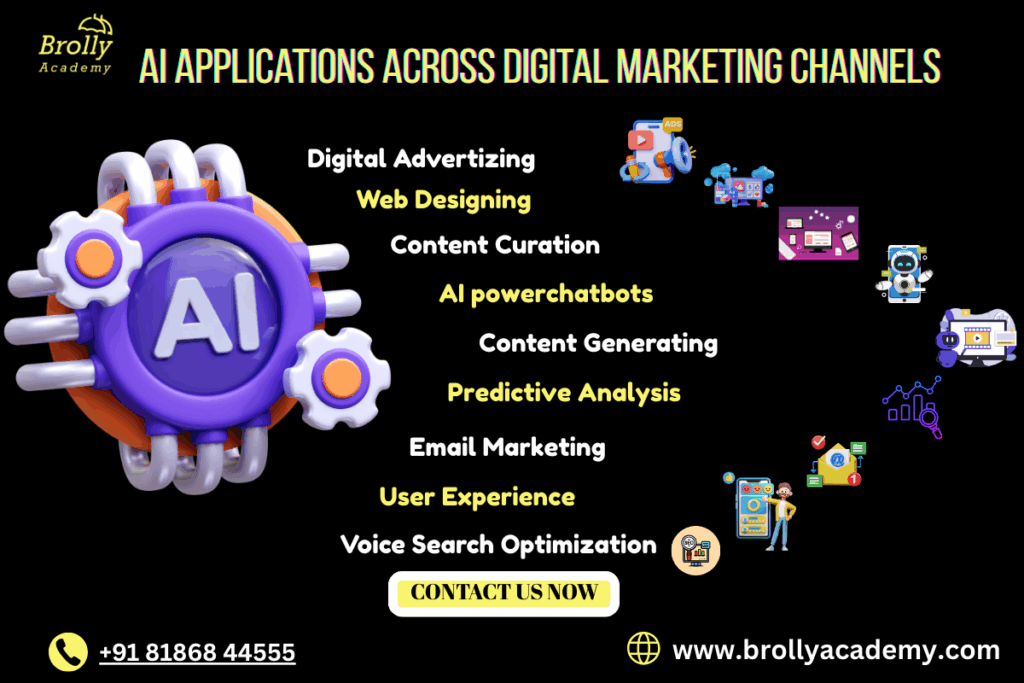
Table: AI Applications Across Digital Marketing Channels
Digital Marketing Channel | AI Applications | Benefits |
Search Engine Optimization (SEO) | Keyword analysis, content optimization, SERP prediction, technical audits | Higher rankings, increased organic traffic |
Social Media Marketing | Content scheduling, sentiment analysis, trend prediction, auto-replies | Higher engagement, consistent posting |
Email Marketing | Personalized emails, send-time optimization, automated workflows | Better open rates, improved conversions |
Paid Advertising (PPC) | Smart bidding, audience targeting, ad copy optimization | Reduced ad spend, higher ROI |
Content Marketing | AI content generation, topic prediction, content scoring | Faster production, better relevance |
Website Experience (UX) | Heatmap analysis, recommendation systems, chatbot support | Improved conversions, smoother navigation |
Product recommendations, dynamic pricing, abandoned cart automation | Higher sales, better customer retention | |
Customer Service & CRM | AI chatbots, sentiment analysis, lead scoring | Faster support, improved customer satisfaction |
Analytics & Insights | Predictive analytics, customer behavior analysis, performance forecasting | Data-driven decisions, accurate predictions |
Influencer & Brand Marketing | AI influencer matching, audience authenticity checks | Better brand alignment, reduced fraud risk |
Conclusion: The Growing Role of AI in Digital Marketing
- The role of AI in digital marketing has transitioned from being a futuristic concept to becoming an operational necessity across industries.
- As brands compete in data-driven environments, strategic adoption of AI allows companies to refine campaign strategies, automate repetitive workflows, strengthen customer journeys, and deliver meaningful personalization at scale.
- AI systems work beyond the surface level of marketing activities. They analyze billions of data points, detect user intent, optimize campaigns in real time, and generate personalized experiences that would otherwise require extensive human intervention.
- With emerging technologies such as predictive analytics, natural language processing, machine learning, and generative artificial intelligence, businesses can now approach marketing with precision and intelligence.
Why AI is No Longer Optional
Modern consumers expect tailored experiences, quick responses, and value-driven content. AI enables marketers to fulfill these expectations by:
● Delivering personalized product recommendations
● Enhancing targeting precision
● Reducing human error and operational costs
● Improving marketing ROI
● Driving consistent and scalable customer engagement
Businesses that avoid AI risk falling behind competitors who leverage automation, predictive behavior modeling, and real-time optimization.
Future Outlook: What Comes Next
As AI continues to evolve, digital marketing strategies will shift towards:
● Fully automated campaign execution
● Hyper-personalized user experiences
● Integration with AR/VR-based digital ecosystems
● Voice-enabled search and AI-powered commerce
● Virtual brand agents and intelligent assistants
The future landscape of marketing belongs to organizations that can leverage AI—not just as a supplement, but as the core framework behind strategic decision-making.
FAQs
1. Why is AI important in digital marketing?
AI enhances efficiency, accuracy, personalization, and decision-making. It helps marketers automate processes, analyze customer data, optimize campaigns, and improve ROI.
2. Can AI replace human marketers?
AI supports marketing automation and decision-making but cannot fully replace human creativity, critical thinking, and emotional intelligence. Instead, AI works as an intelligent assistant.
3. Which industries benefit most from AI-driven marketing?
E-commerce, entertainment, healthcare, finance, education, and technology sectors benefit significantly from AI marketing applications.
4. Is AI marketing expensive to implement?
Costs depend on platform size and adoption level. However, long-term benefits include reduced labor cost, improved conversions, stronger targeting, and higher ROI.
5. What skills are required to use AI in marketing?
Skills include data literacy, marketing automation, analytics understanding, campaign management, and basic AI tool knowledge
6. How does AI improve digital marketing?
AI improves digital marketing by automating repetitive processes, enhancing audience targeting accuracy, generating personalized recommendations, predicting user behavior, and optimizing advertising campaigns in real time. This increases efficiency, engagement, and overall marketing return on investment.
7.Can AI replace human marketers?
AI cannot completely replace human marketers. While AI can automate data-driven tasks and optimization, human creativity, brand strategy, emotional reasoning, and ethical decision-making remain essential. AI functions as an advanced support system rather than a replacement.
8.What are the best AI tools for digital marketing?
Some widely used tools include ChatGPT, Jasper AI, Surfer SEO, HubSpot AI, Google Performance Max, Copy.ai, ManyChat, Canva AI, Adobe Firefly, and SEMrush AI Writing Assistant. The right tool depends on campaign goals, budget, and digital ecosystem maturity.
9.What skills are required to use AI in marketing?
Skills include prompt engineering, AI analytics interpretation, content automation workflows, ethical AI practices, marketing automation, data-driven decision-making, and an understanding of digital campaign structures.
10.What is the future of AI in digital marketing?
The future will introduce fully autonomous marketing ecosystems where AI manages targeting, creative variations, scheduling, personalized messaging, and adaptive advertisements. Trends such as voice commerce, sentiment-driven content, predictive experience design, and AI-powered virtual ambassadors will become mainstream.
11.What is the role of AI in digital marketing?
The role of AI in digital marketing is to make marketing smarter, faster, and more personalized by using data-driven intelligence. AI helps businesses understand customer behavior, automate repetitive tasks, improve targeting, and optimize campaigns for better results.
12.How does AI improve customer targeting?
AI improves customer targeting by analyzing large volumes of user data to identify patterns, interests, and behavior more accurately than manual methods. It then delivers personalized messages to the right audience at the right time, maximizing engagement and conversions.
13.Can AI be used for content creation?
Yes, AI can be used for content creation by generating blogs, social media posts, captions, and ad copy based on user intent and trends. It speeds up the content process while maintaining consistency, creativity, and data-driven relevance.
14.How does AI help in SEO?
AI helps in SEO by analyzing search patterns, keywords, and user behavior to optimize content for better rankings. It also automates tasks like topic research, on-page optimization, and performance tracking for faster, more accurate SEO results.
15.What is AI-powered marketing automation?
AI-powered marketing automation uses intelligent algorithms to handle repetitive tasks like email campaigns, lead nurturing, and ad optimization automatically. It improves accuracy, saves time, and delivers personalized experiences to customers at scale.
16.How does AI enhance social media marketing?
AI enhances social media marketing by analyzing user behavior to deliver personalized content, optimize posting times, and boost engagement. It also automates tasks like content scheduling, sentiment analysis, and ad targeting for better campaign performance.
17.What is the role of AI in paid advertising?
AI improves paid advertising by automatically optimizing bids, targeting the right audiences, and enhancing ad placement for maximum ROI. It analyzes real-time data to predict performance and adjust campaigns for better conversions.
18.How does AI help with customer engagement?
AI boosts customer engagement by delivering personalized messages, recommendations, and real-time interactions across digital channels. It analyzes user behavior to create meaningful, timely, and relevant experiences that keep customers connected.
19.Is AI useful for email marketing?
Yes, AI is highly useful for email marketing as it personalizes subject lines, content, and send times for each user. It also improves open rates and conversions by analyzing customer behavior and automating targeted email campaigns.
20.What is predictive analytics in digital marketing?
Predictive analytics in digital marketing uses AI-driven data patterns to forecast customer behavior, trends, and future actions. It helps marketers make smarter decisions, optimize campaigns, and target the right audience at the right time.
21.How does AI help in improving conversion rates?
AI improves conversion rates by analyzing user behavior to deliver personalized recommendations, messages, and product suggestions at the right moment. It also optimizes landing pages, ads, and customer journeys based on real-time insights for higher conversions.
22.Can small businesses use AI in digital marketing?
Yes, small businesses can easily use AI tools to automate marketing tasks, target the right audience, and improve campaign performance at low cost. Affordable AI platforms help them compete with larger brands through smarter insights and personalized marketing.
23.What are AI chatbots in marketing?
AI chatbots in marketing are intelligent virtual assistants that automate customer conversations, answer queries, and provide instant support. They enhance user engagement and streamline customer service by offering personalized, real-time responses.
24.How does AI help in competitor analysis?
AI helps in competitor analysis by automatically tracking competitors’ keywords, content, ads, and online performance. It provides data-driven insights that help businesses refine strategies and stay ahead in the market.
25.Is AI reliable for analyzing customer feedback?
Yes, AI is highly reliable for analyzing customer feedback because it can instantly scan large volumes of reviews, comments, and messages. It identifies patterns, sentiments, and common issues to help businesses make smarter improvements.
26.Will AI replace digital marketers?
AI will not replace digital marketers but will enhance their capabilities by automating repetitive tasks and providing deeper insights. Marketers who learn to work with AI tools will become more efficient, creative, and in-demand.Lorem ipsum dolor sit amet, consectetur adipiscing elit. Ut elit tellus, luctus nec ullamcorper mattis, pulvinar dapibus leo.
27.How does AI improve website user experience?
AI improves website user experience by personalizing content, product recommendations, and navigation based on user behavior. It also analyzes patterns to optimize layouts, speed, and interactions for smoother, more engaging browsing.
28.What skills are needed to use AI in digital marketing?
You need skills in data analysis, basic machine learning concepts, and understanding AI tools used for automation and optimization. Knowledge of SEO, content strategy, and campaign management helps in applying AI effectively.
29.What is the future of AI in digital marketing?
AI’s future in digital marketing is driven by hyper-personalization, smarter automation, and real-time decision-making across all platforms. As AI evolves, marketers will use more intelligent tools that boost efficiency, accuracy, and overall campaign performance.
30.How does AI help in analyzing customer journeys?
AI helps analyze customer journeys by tracking user behavior across all touchpoints and identifying patterns in how they interact with brands. It then uses this data to predict needs, personalize experiences, and optimize every stage of the customer journey.